
This is a topic that could get very ‘deep’ very quickly so I’ll define my intentions clearly from the start to avoid confusion or the wandering off of the beaten track. The idea of subconscious images retrieved from sleep is a rich source of inspiration and awe, without a doubt taken up bravely in the early 1900’s by a group of pioneering thinkers under Bretton’s umbrella of ‘The Surrealists’. Poets, writers and artists collaborated in a revolutionary way of thinking and expressing, mainly due to the research that was going on concerning the human mind and psychology at the time, being brought to ‘the surface’ by a leading psychologists such as Sigmund Freud and Carl Jung.
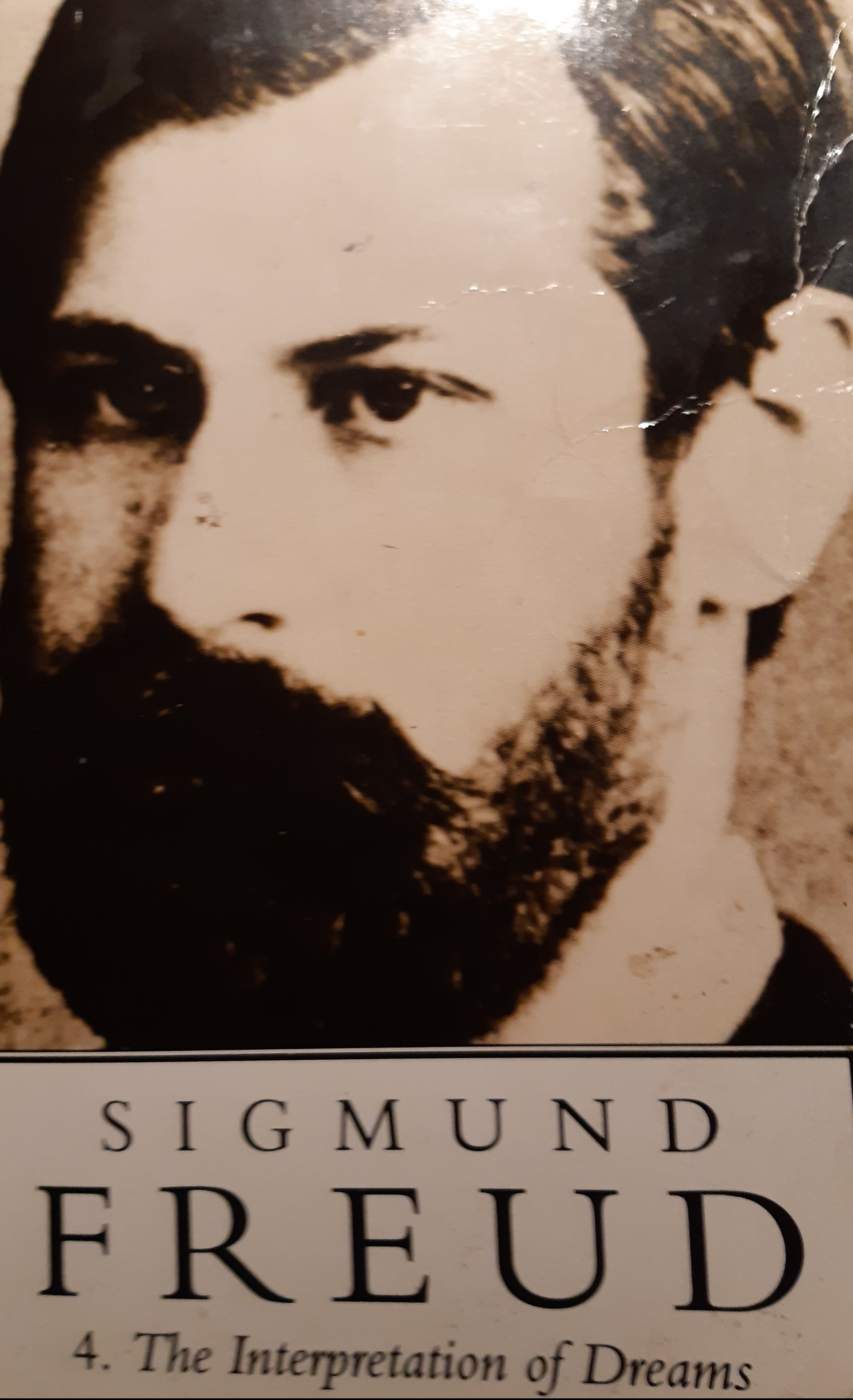
This was a match made in heaven for both psychologists and artists with psychology papers around the time peppered with references to ‘images’, ‘creative’, ‘minds’ and ‘symbols’, before the artists even got a wiff of the concept; it was inevitable that a ‘study’ of the mind would influence and fuse with a ‘representation’ of images of the mind.
This was the premise for my comparison. What interested me was:
*To show the connections, with examples, of how the 3 main…..
IDEAS from the PSYCHOANALYSIS movement:
- DREAMS
- SYMBOLS
- FREE ASSOCIATION (AUTOMATISM)
were portrayed as…
IMAGES by the SURREALIST movement.
My main focus here is the conversion of an IDEA, into an IMAGE, and to contrast and compare how the different surrealist artists went about it.
Psychoanalysis was a method of deciphering images brought on in dreams, used to find out and underline the meanings of the images with regards to the patients mental state. The leading doctors in this field that stand out were Dr. Sigmund Freud and Carl Jung who managed to identify links between the abstract symbols that repeated in a patients dreams, and their waking conscious life. Freud paved the way to extract this information by free, or word association, whereby the patient would freely talk through the dream and make links between the images and scenarios with relation to the dreamers past and current experiences, thus building up a picture of the person’s mental state.
The links between DREAMS, SYMBOLS, and FREE ASSOCIATION are mentioned in both Freud’s ground breaking book ‘The Interpretation of Dreams’, and various papers written by Jung, where the binding of mental images, creativity and artistic scope are lay down:
(2)”…The analysis of this last biographical dream is clear evidence that I recognised the presence of symbolism in dreams from the very beginning”.
Freud believed that, (3) “The peculiar plasticity of the psychical material (in dreams) must never be forgotten.” and commenting on a fellow psychologist’s (Schiller) letters stating (4) “where there is a creative mind, Reason – so it seems to me – relaxes its watch upon the gates, and the ideas rush in pall-mell”, commented by Freud, “…to be found in all creative minds…distinguishes the artist from the dreamer…”
These ideas were published in 1900 and started to prove fertile ground for a fresh perspective of confronting art by the Surrealists that began around 1920.
Jung emphasised the importance of symbols within dreams in his paper entitled ‘Man and his Symbols’ where he stated’ (5) “Man also produces symbols unconsciously and spontaneously in the form of dreams”.
With these concepts firmly in place we can take a look at how the various surrealist painters explored these ideas.

The Exquisite Corpse…(6) ‘also known as exquisite cadaver, is a method by which a collection of words or images is collectively assembled. Each collaborator adds to a composition in sequence…by being allowed to see only the end of what the previous person contributed.’
This was a game played by the Surrealists, noted by Andre Breton, Yves Tanguy and Marchel Ducamp among others, which mimics the psychological method of free association where by a patient would freely link images together, they would link drawings together on a folded piece of paper, not knowing what preceded, creating a grand picture, or image that was not planned and would only reveal itself once the train of thought, or images was complete. This idea of attempting to tap into the unconscious without the obstruction of rational thought, or the conscious was a theme declared by Breton in his first surrealist manifest …………..(8) “SURREALISM, n. Psychic automatism in its pure state, by which one proposes to express — verbally, by means of the written word, or in any other manner — the actual functioning of thought. Dictated by the thought, in the absence of any control exercised by reason, exempt from any aesthetic or moral concern.”
Salvador Dali managed to tackle these three themes spanning throughout his career after becoming influenced by the surrealist around the mid to late 1920’s.
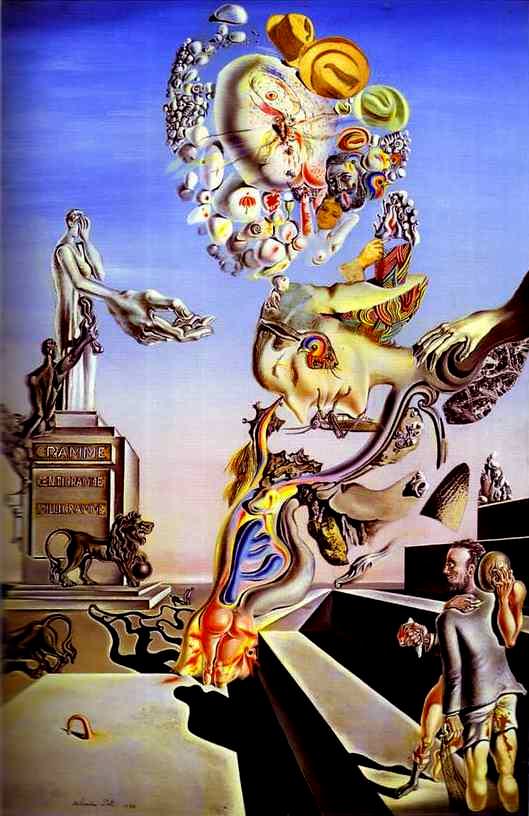
A perfect place to start was Dali’s Lugubrious Game, being a perfect representation of all three themes. The DREAM composition is represented by the jumbled, amorphic amalgamation of the grotesquely disproportional fusion of body parts both in the fore/backgrounds that successfully describe how a dream can often appear to the dreamer, in vague, distorted and seemingly random images.
However, on closer inspection we can see the early stages of some of Dali’s trademark SYMBOLS that were repeated throughout his work

(10) Detail ‘The Great Mastibator’ 1929 
(11) Detail ‘Apparatus and Hand’ 1927 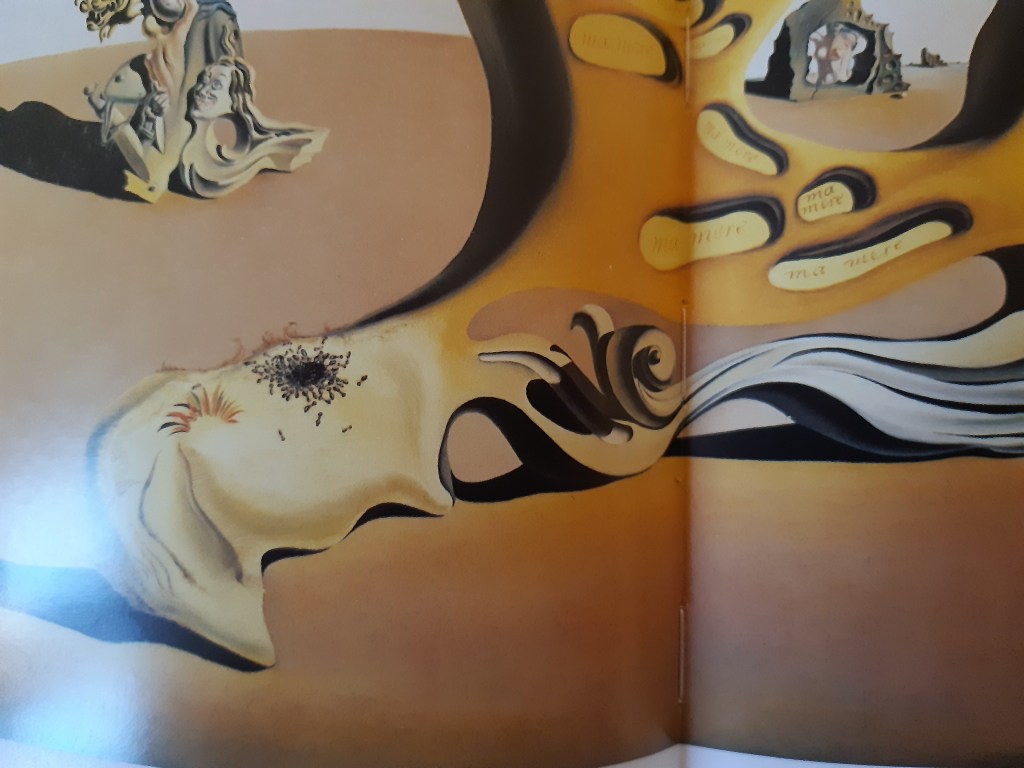
(12) Detail ‘The Enigma of Desire’ 1929
including the lion, (said by Freud to represent the father figure), the hat (male genitalia), the grasshopper clinging to the face (Dali’s personal fear), the enlarged hand, (male masturbation) and a sense of neurotic shame in the figure in the foreground and also the statue. Some of these images were straight from Freud (hat,lion), and the rest were Dali’s personal images that follow Freud’s ideas of neurosis, fears and obsessions being the main driving emotions of dreams. Dali often repeated the images of ants and later clocks to signify a devouring or disintegration of time.
The AUTOMATISM is evident in composition of images free flowing out of what appears to be the artists head, morphed and tangled into one another just as Freud’s patients would have recalled their trail of images from their dreams. This similar trail of images would become one of the artists trademark styles and can also be seen in ‘Imperial Monument to The Child Woman’.

(13) ‘Imperial Monument to The Child Woman’ c.1930
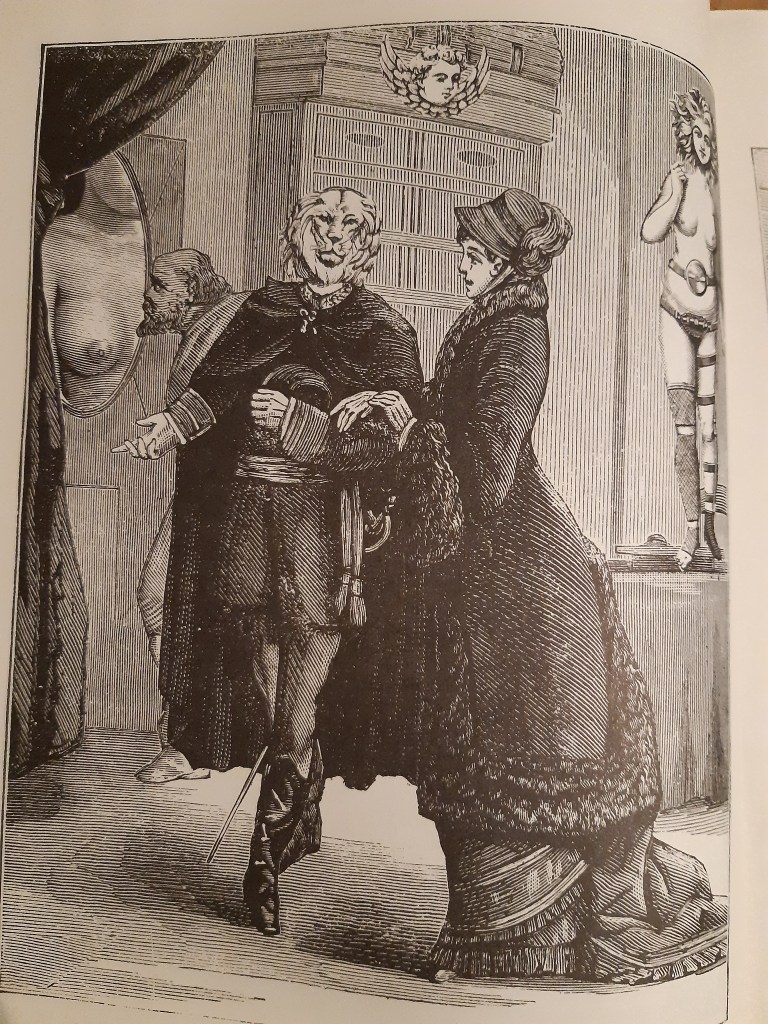
Other notable artists that expressed these ‘dream concepts’ included Max Ernst and can be seen in his Surrealist collage novel ‘Une Semaine De Bonte’.He interestingly uses collage from old Victorian illustrated pamphlets to arrange bizarrely striking and slightly disturbing pictures that tell a story depicting in a dis-attached chaotic dream like set of images. Here we can see the use of repeating SYMBOLS including the lions head again, flowing water, wings, bird heads and anatomical parts of humans and creatures. The pictures have been arranged to tell a story like the FREE ASSOCIATION images that would come forth from a psychoanalysis session.
https://en.wikipedia.org/wiki/
Plate 2 Sunday, Mud, The Lion of Belfort
Plate 9 Sunday, Mud, The Lion of Belfort 
Plate 32 Sunday, Mud, The Lion of Belfort
Ernst broke the book into 7 sections, one for each day of the week, using a theme and a symbol that ran through each section. The examples above were from the first section ‘Sunday’, element ‘Mud’, example ‘The Lion of Belfort’. (14), (15), (16).
The second section ‘Monday’ used the symbols, element ‘Water’, example ‘Water’ as below, (17), (18).

Plate 3 Monday, Water, Water 
Plate 16 Monday, Water, Water

We can see in his forth section, Wednesday he has used the prompts, element Blood, example Oedipus (19).
I find this a very clever way to convey the ideas of a story through SYMBOLS, linking them together as you would a dream during psychoanalytical session and hence the whole story can be understood through images similar to the way a DREAM would be interpreted. A very different method from the artists mentioned above, however still in keeping with the ideas of DREAMS, SYMBOLS and FREE ASSOCIATION.
It was interesting to see how different artists were able to visualise and intemperate words into images. I find the whole idea of unconscious images and dreams a fascinating subject, and as the surrealists did in the 1920’s, a fertile ground for inspiration to create a style of painting that transcends the three dimensions and adds the extra depth of symbols, meanings, and a blur between what is seen, what is thought, and what is dreamed, being three very different levels of understanding.
References
(1) Photo of Cover picture of ‘Interpretation of Dreams’ Freud S. 1899. Volume 4, Penguin Books.
(2) – (4) Quotes taken from ‘The Interpretation of Dreams’ Freud S. 1899. Volume 4, Penguin Books.
(2) P466 Quote, “The analysis of….the very beginning”, Freud S.
(3) P469 Quote “The perculiar plasticity…”, Freud S.
(4) P177 Quote “Where there is a creative mind…distinguishes the artist from the dreamer.”, Freud S.
(5) P18 Quote “Man also produces…form of dreams”, Jung C. ‘Man and His Symbols’, papers written by Jung. https://www.scribd.com/document/427908922/Carl-Gustav-Jung-Man-and-his-Symbols-19xx-pdf
(6) Quote “also known as exquisite cadaver…what the previous person contributed” Wikipedia. https://en.wikipedia.org/wiki/Exquisite_corpse
(7) ‘Cadavre Exquis’ Breton A., Eluard N., Hugo V., Eluard P. 1930. Graphite on paper, 310x 240mm. https://www.tate.org.uk/art/artworks/breton-eluard-hugo-exquisite-corpse-t12005
(8) “SURREALISM, n. Psychic automation…moral concerns.” Definition as written out by Breton A. Manifesto of Surrealism 1924. https://www.tcf.ua.edu/Classes/Jbutler/T340/SurManifesto/ManifestoOfSurrealism.htm
(9) ‘The Lugubrious Game’ Dali S. 1929. Oil and collage, 18″x12″. https://dali.com/dali-let-hang-lugubrious-game-29/
(10)-(13) Photographs taken from ‘Salvador Dali’, Jessica Hodge. Grange Books 1996-97
(10) P44 Detail ‘The Great Masturbator’ Dali S. 1929. Oil on canvas, 44″x46″. Spanish State Patrimony
(11) P35 Detail ‘Apparatus and Hand’ Dali S. 1927. Oil on panel, 24.5″x18.25″. Collection of Mr and Mrs A. Reynolds Morse.
(12) P41 Detail ‘The Enigma of Desire’ Dali S. 1929. Oil on canvas, 43.75″x59″. Christie’s London.
(13) P42 ‘Imperial Monument to the Child Woman’ Dali S. c.1930. Oil on canvas, 142x81cm. Private collection New York.
(14)-(19) Photo ‘Une Semaine De Bonte’ Ernst M. 1976. Dover Books
(14) P4 ‘The Seven Deadly Elements, First book Sunday, Element Mud, Example The Lion of Belfort’ Plate 2, collage and printing.
(15) P11 ‘The Seven Deadly Elements, First book Sunday, Element Mud, Example The Lion of Belfort’ Plate 9, collage and printing.
(16) P34 ‘The Seven Deadly Elements, First book Sunday, Element Mud, Example The Lion of Belfort’ Plate 32, collage and printing.
(17) P43 ‘The Seven Deadly Elements, Second Book Monday, Element Water, Example Water’ Plate 3, collage and printing.
(18) P56 ‘The Seven Deadly Elements, Second Book Monday, Element Water, Example Water’ Plate 16, collage and printing.
(19) P117 ‘The Seven Deadly Elements, Forth Book Wednesday, Element Blood, Example Oedipus’ Plate 1, collage and printing.
 Eeyanski Arts