A self portrait is a very personal feat to execute. It is one thing to try and portray someone else’s emotions and inner feelings, but to share your own can be quite daunting. On the other hand, I guess no-one knows you quite like yourself, and portraying yourself can be quite a statement, as long as you get it right!
I’m going to choose a hand full of artists from a range of genres and eras with the sole intention of comparing the artist to the portrait and how they expressed themselves and whether it was successful and why.
Another interesting cue that can be taken from a portrait is an idea of the vogue of the era it was painted in. Trends such as clothes, painting styles, type of paint used can be detected subtly and hints of the state of the socio-economical status might also be apparent.
Rembrandt.
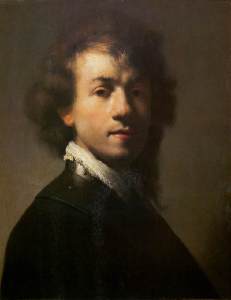
Rembrandt was famous for his self portraits, completing over 70 in his life time which give not only an insight into his changing appearance, but also to his developing styles and maturing insights. An early example of this can be seen in the young artist portrait (1) ‘Self Portrait with Lace Collar’, showing the experimentation with light and shade, and the budding development of his use of chiaroscuro which he became famous for. The lace collar could be an indication of the style of the upper class of the day, as he was not born into poverty, however his earlier self portraits such as (2) ‘The Artist in his Studio,’ clearly depicts a modest bare studio with cracked walls, stood in a muffled overcoat Rembrandt seems to play down any overly lavish props and guises in the majority of his self portraits.
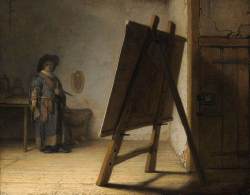
(2) ‘The Artist in His Studio’ 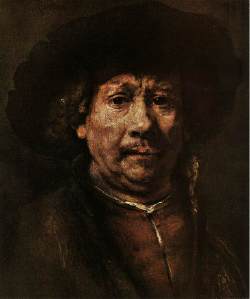
(3) ‘Little Self Portrait’
(3) ‘Little Self Portrait’ is a later painting which shows the maturation of his mastery of light and shade, but also hints to a sadness in his eyes and expression which would become more apparent as the years passed by. Almost like a melancholy knowing of not so much an inner turmoil, but a realisation of life itself, how it comes to pass, and the inevitable end, similar to Gogh’s portraits, the artists eyes convey a ‘knowing’ look with a hint of haunting.
That’s the only way I can describe it, powerful, a look that could only come from a life time of perception, inner reflection, contemplation, and finally realisation. I know these terms are abstract, but they are the only way I can describe them, seeing them in so many other artists portraits, I think there could be something that bonds these people through the above mentioned experiences.
Van Gogh.
Van Gogh’s self portrait of 1889 (4) ‘Self Portrait’ gives away a few hints towards the inner psyche of the artist at the time, strikingly compared to his work of the same year, (5) ‘Self Portrait with Bandaged Ear’, these two paintings are a great contrast almost in a before and after sketch. Both using erratic, disorientating swirls of movement in the background which could almost represent the artists frame of mind, which matches the lonely, void, but piercing stare of the eyes, desolate of feeling or emotion. Even though the eyes and mouth on both pieces tell the same story, it’s the dramatic contrast in colour of the background that gives away the real inner turmoil that the artist is going through.
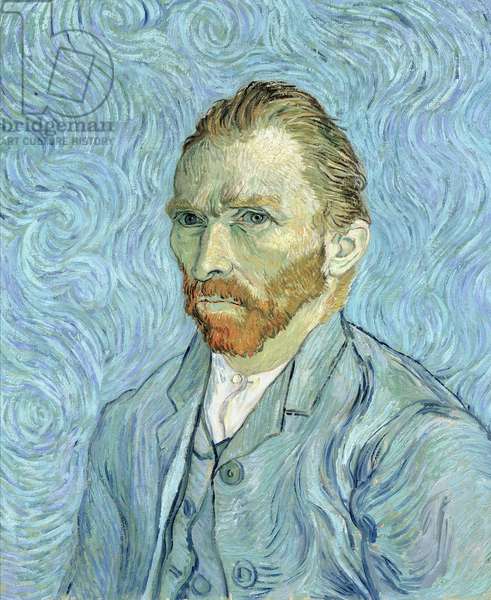
(4) ‘Self portrait,’ Gogh, Vincent van 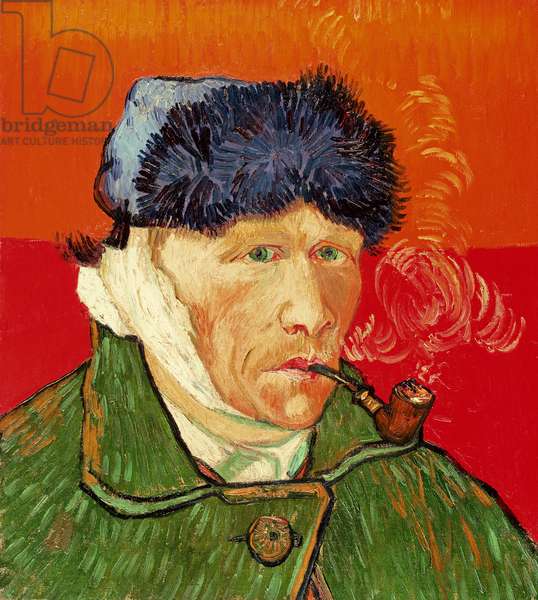
(5) ‘Self Portrait with Bandaged Ear,’ Gogh, Vincent van
Edvard Munch.
In another famous portrait we can see a similar effect to that of Gogh’s in Munch’s (6) ‘The Scream’.
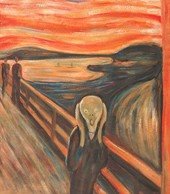
Again we see raging red hues, confusing swirls of ambiguous clouds and movement, and an altogether claustrophobic segregation of the artists mind, all three portraits are hauntingly looking into the viewers eyes to engage their attention and communicate there anguish. The dress in both Gogh’s paintings point towards poverty and indicate his vagabond lifestyle, and a similar situation can be taken from the cheap materials, pastel, crayon on cardboard that Munch is using for his self portrait.
At this point I am starting to question whether it would be a good idea to actually become an artist or not!
Lucian Freud.
A superb example of an artists mind frame, meticulously scrutinizing view point and attention to detail, tones and planes of light are all apparent in Lucian Freud’s work, and especially in his self portraits.
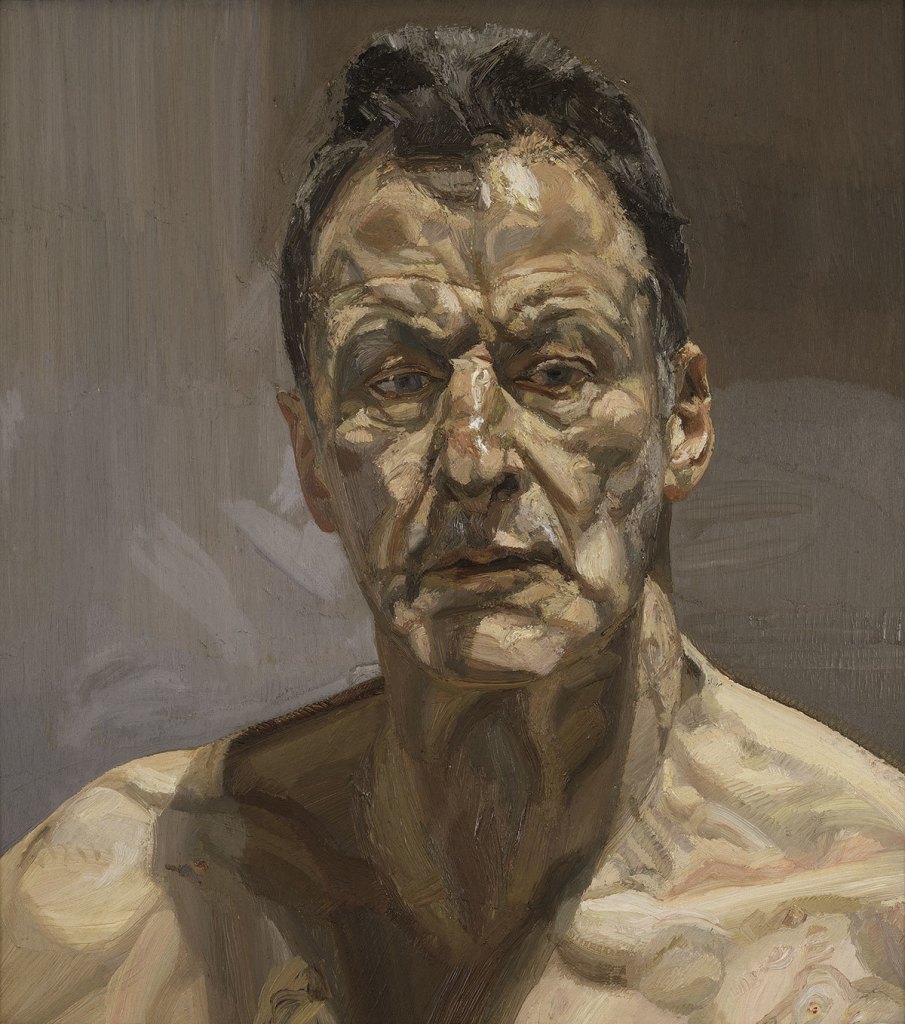
Non more self explicit than (7) ‘Reflection (Self Portrait)’, a perfect example of how Freud could breakdown and pick out the subtleties of flesh tones, raw, unabridged and exposed, every detail of plane change, and light and shade are put on the table for all to examine. I’m sure a lot of his models literally felt like a piece of meat. The style and hues match the hard gritty reality that seem s to be scarring his expression, and for the portrait the artist is not looking a t the viewer. Personally, I don’t think he needs to, and I think he knows he doesn’t need to, because everything that needs to be said about the artist has been displayed in the construction of the painting. The marred face, crooked broken nose, harsh unforgiving tones and brow lines of intense inner thoughts and workings portrays the artist to a tee.
As I mentioned above about the emotion behind the eyes, every portrait listed seems to have the same defeated, ‘knowing’ look to them, apart from Munch’s ‘The Scream’ where he probably bypassed that step and headed straight into insanity without contemplating it first. I also noted that none of the artists are smiling. Personally I don’t think the impact would have been so great.
Francis Bacon.
Sticking on the ‘inner turmoil’ side of things, ironically Francis Bacon apparently had no academic training in art, yet managed to capture the insides of a human psyche in such a brutally honest way that I can only describe his ability as ‘pure’.
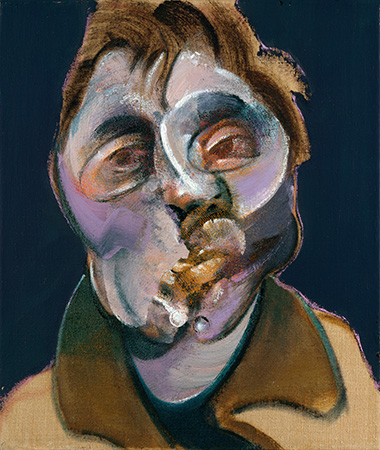
Crude, twisted, raw, I could go on, but Bacon’s mastery of emanating his feelings and emotions through his primitive use of colour, relying on movement of brush strokes to guide the feelings and envelope to viewer directly into his psyche, for me is touching on genius. Not in the way of Rembrandt’s genius, or Gogh’s ability to portray his emotional state, but to bore into the viewers own emotion to a point of unsettling. I can appreciate the unsettle gaze of Gogh or even Freud, but I find something in Bacon’s portraits that leave me at first deeply penetrating, followed by awe.
Many of his other works show the same marks of a paint brush that has been guided not just by a hand, but by a soul, and this to me is the difference between a painter and a creator. There is no technical detail as we see in Freud’s work so to say, but Bacon has stripped all that down to the very essence of emotion, bare, raw, and powerful. A side note, also suggesting that the eyes of this portrait, although not looking at the viewer, also hold the same characteristics of the above mentioned portraits, sad, distant, numb, but with a knowing intelligence that can only come from inner experience.
What I have gained from looking at artists self portraits is that an artists self portrait is a portrait of themselves, being much more personal than an outside portrait. (Try posing into your phone camera for a shot, then angle the camera like your getting ready for a business meeting and see the difference.) Drawing someone you know is one thing, but drawing yourself, and depicting your self is another. It gives the artist a chance to, (because we are the only ones who know ourselves best), portray our own psyche in the most accurate way, using the tools, techniques and skills that have developed in parallel with the personal psyche, to show as a beacon as to how we feel. Look at any of the above examples and take into consideration the colours, brush strokes, facial expressions, use of paint,…..(and lack of smiles!!!!) to get a feeling of what emotion the artist wanted to get across. Bearing in mind that all these artists were (if not then, defiantly now), geniuses in their own right.
The one thing I did notice is that if you cover up most of the face, and just left the eyes, you can still get a good judgment of the artists mood and motivation for the painting….something I think I will keep in mind.

References.
(1) ‘Self Portrait with Lace Collar’ Rembrandt H. c 1629, oil on canvas. 38 x 29 cm
Mauritshuis, The Hague. Web: https://www.wga.hu/html_m/r/rembrand/27self/06sp1629.html
(2) ‘The Artist in his Studio’ Rembrandt H. c 1626, Oil on canvas, 25 x 32 cm
Museum of Fine Arts, Boston. Web: https://www.wga.hu/html_m/r/rembrand/27self/01sp1626.html
(3) ‘Little Self Portrait’ Rembrandt H. c 1657, Oil on wood, 49 x 41 cm
Kunsthistorisches Museum, Vienna. Web: https://www.wga.hu/html_m/r/rembrand/27self/15sp1657.html
(4) ‘Self Portrait’ Gogh V. 1889, oil on canvas, 65×54.5cm. Musee d’Orsay, Paris, France. Web: https://www.bridgemanimages.com/en/gogh/self-portrait-1889-oil-on-canvas/nomedium/asset/32212
(5) ‘Self Portrait with Bandaged Ear’ Gogh V. 1889, oil on canvas, 51x45cm. Private collection. Web: https://www.bridgemanimages.com/en/gogh/self-portrait-with-bandaged-ear-1889-oil-on-canvas/nomedium/asset/213437
(6) ‘The Scream’ Munch E. 1893, oil on canvas, Oil, tempera, pastel and crayon on cardboard 91×73.5cm. Munich Museum, Oslo. Web: http://www.visual-arts-cork.com/famous-artists/munch-edvard.htm
(7) ‘Reflection’ (Self Portrait)’ Freud L. 1985, Oil on canvas. 55.9×55.3cm. Private collection. Web: https://www.royalacademy.org.uk/exhibition/lucian-freud-self-portraits#image-gallery
(8) ‘Self Portrait’ Bacon F. 1969, oil on canvas, 35.5×30.5 cm. Web: https://www.francis-bacon.com/artworks/paintings/self-portrait-2
 Eeyanski Arts