After brainstorming some ideas on composition I split the concept up into three main categories that would affect my judgement on the composition of a still life.
Position of the objects is a large factor in still life which can help with the ‘story’ of the piece. Not just the position of the objects in relation to each other, but the angle that it is drawn and how close it is. I experimented with getting right up close to what I was drawing and found that the perspective vastly distorted the image to a comical, even unrecognisable point. I enjoyed doing this as I had to keep moving from my drawing position to my paper so it was a good exercise to practise drawing from memory as well.

Drawing from above or below also enhanced the emotion of the objects, drawn from below and the drawing became quite dominant while the same sketch from above quite pitying and lonely.

Looking down 
Looking up
Another thing to influence composition is texture. Whether to put similar textured objects together or contrast them with opposites to create a bit more drama. This could also go for sharp and soft, using contrast is a great way to create a shock, uncomfort, interest, surprise, or just to draw attention to a focal point in the picture. With regards to subject matter, I played around with contrasting ideas of objects such as ‘home and away’, ‘lost and found’ and ‘man made and natural’. Putting together the composition with contradicting objects like a shell, keys and wood panel, ‘lost and found’ or a coffee grinder, shell and drift wood, ‘home and away’ was a fun way to look at grouping different objects together to try and create more of a story.


Here I tried to portray three different textures, a smooth bottle, ridged twisting shell and a ruff piece of woven cloth, but tried to unit them all by drawing them in the same style. I used black and white conte pencils on brown paper with a rubber to pick out the details
Light is an important part of composition with regards to the shadows cast, how each object can conceal the other as well as affecting the mood of the picture. In George De La Tour’s (1) ‘Mary Magdalene with a Night Light’ the whole focus of the picture is the illuminated face and book by the light of the candle, creating sharp contrast in the picture and drawing the viewers focus to the main theme of the painting, ie, the face, book and the skull.

The most interesting aspect of composition I found was the impact of the view point. Experimenting with overviews, under views and close up’s I decided on a close up of a coffee grinder, shell and driftwood. This gave me a good contrast of textures, including the ideas of ‘home and away’ and drawing the composition in a dynamic close up style that gave it an interesting twist.
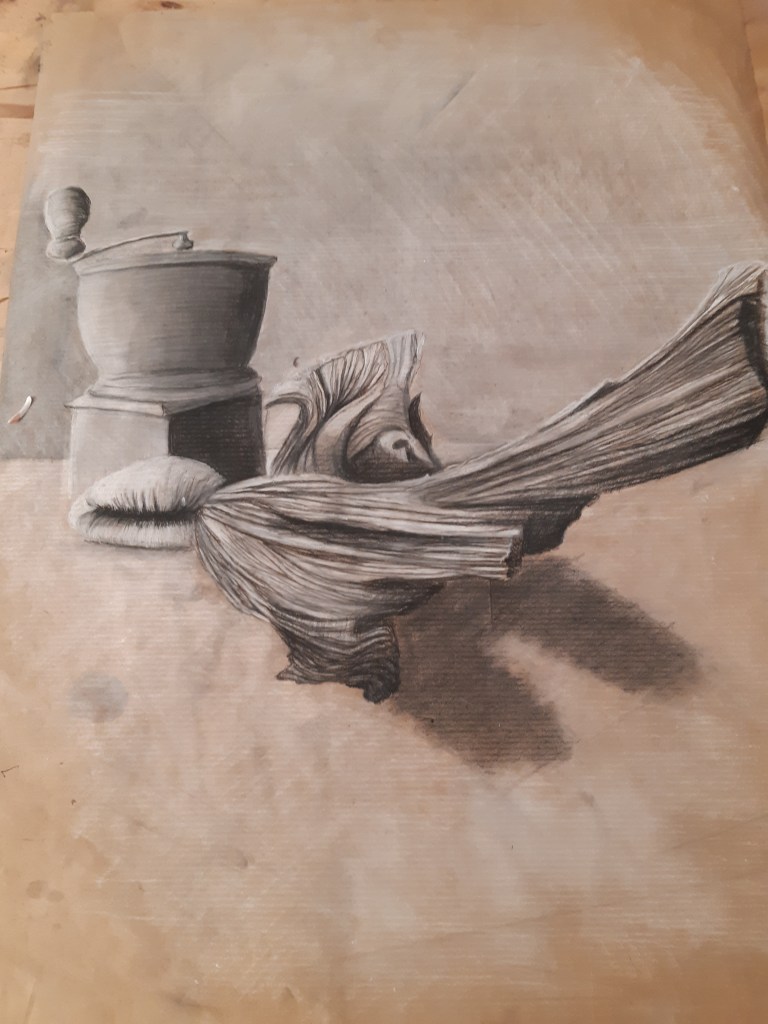
I used black and white conte sticks on a brown background to give give me flexibility on the the dark, medium tones and the highlights so I could depict the texture of the driftwood and also the smooth surface of the coffee grinder, with a contrast of texture from each object.
This was a very interesting exercise to look into the influence of how a composition can dictate the mood and overall impact of a still life, and how it can be used to convey symbols and meanings that are not seen straight away.
Another interesting idea of composition was the concept of repeating patterns. Something I noticed in my kitchen was a collection of everyday cooking items, all grouped together in a composition of circular vessels, (this was just drawn and not arranged,)

I think the repeating circles and boxes give it a unified un-arranged arrangement if that makes sense which is something I saw in my clothes rack as well.

It was something about a group of objects that are put together and they become familiar because they are together. Maybe each item on the clothes rack by itself might be unrecognisable, but put with all the other clothes it sets a scene that we’re familiar with. I think that could be a worthy note when thinking about composition and the impact or affect it is capable of having on the viewer.
References.
(1) ‘Magdelene with The Smoking Flame’ De La Tour G. oil on canvas, 1.28×0.94 m, c. 1640–45. https://www.google.com/search?q=george+de+la+tour+the+night+light&source=lnms&tbm=isch&sa=X&ved=2ahUKEwjt_dTV1LHpAhWkUxUIHfugC-QQ_AUoAXoECA8QAw&biw=1280&bih=610&dpr=1.5#imgrc=I0rP9tPFcDlOQM
 Eeyanski Arts