Paintings can be split up into two distinct areas of positive and negative space. The positive space comprises of the objects or subjects of a picture and the negative would comprise of the space around the objects. This is and interesting concept when you start to treat the negative space just as important as the objects themselves and can use it creatively, involving it more as part of the picture instead of it being ‘just’ in the background. It can create a balance in the composition by including the background and create a harmony between the foreground and the background.
It is defined as: ‘Simply put, the definition of negative space is the area around and between a subject.’ (1).
This idea evolved in early Japan where artists were using the concept of ‘MA’ in their paintings. A deeper meaning of using negative or blank space to portray ideas.

I feel that the viewer is left to fill in the gaps with their imagination, creating a mystical and different experience for each viewer. Describing ‘Ma’ is like the space inside the house is what makes it the house, not the actual structure.
The influential designed Alan Fletcher described this concept as: (3) ‘“Space is substance. Cézanne painted and modelled space. Giacometti sculpted by “taking the fat off space”. Mallarmé conceived poems with absences as well as words. Ralph Richardson asserted that acting lay in pauses… Isaac Stern described music as “that little bit between each note – silences which give the form”… The Japanese have a word (ma) for this interval which gives shape to the whole. In the West we have neither word nor term. A serious omission.”
With this in mind set about looking at different ways to depict negative space.

Kitchen utensils
Fruit and candle
Starting out by drawing some simple object with an almost reverse polarity to them I added in the background and kept the objects free of and detail or texture, giving the picture and almost cut and paste silhouette feel to them. This was a really good exercise to start paying more attention to the negative space as opposed to the objects themselves. The pictures turned out to have quite a fun ‘guess who’ element to them like an old living room when all the furniture has been taken out and your left with the silhouettes of them.

What I realised was not only could you use the positive and negative space, but also the shadows of the objects and how they affect the other objects nearby. I found I could do this in a number of ways with great results.
I used objects like a pineapple, bananas, a glass and a candlestick as they could be easily recognisable. Other more unfamiliar objects would not have had the same impact if you were not able to identify them for what the were. Another depiction of negative space using shadow was a picture I took of the back of my van where the shadows of the trees were blocking the sun. Here I also used a contrast of techniques between the object, ‘the van’, water colour, ‘the sky and shadow, and the background and foreground, black fine liner, bringing the ‘cut and paste’, or almost a collage feel to the drawing.

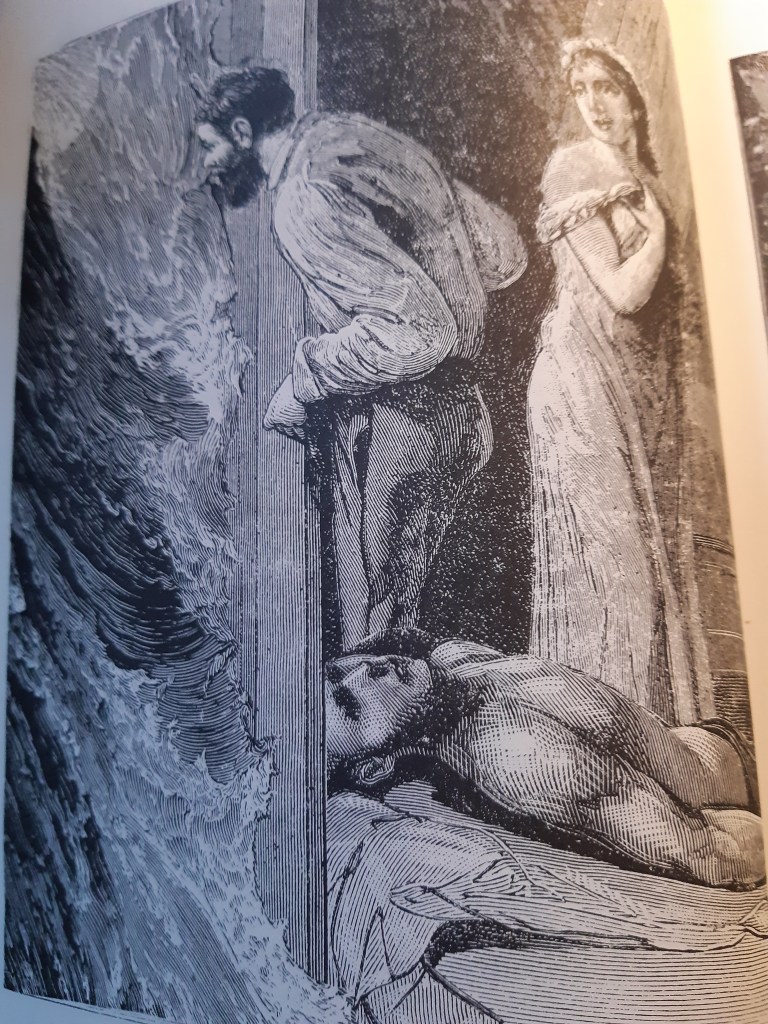
Inspired by the collage aspect of this technique it reminded me of a similar effect you can get with frottage. That clean line of two contrasting textures of surfaces gave me an idea to try out a frottage collage by rubbing graphite onto the background negative space and cutting out a silhouette of a house plant to super impose ontop. I the scanned the image and printed it out in a way similar to Max Ernst with his cut and paste collages.
Although I think this techniqe could be worked on to gain better effects, the results were a bit crude, and the background wasn’t detailed as I imagined, but with a bit more practice this could be a technique that I might revisit at some point. I would just have to work the detail a little finer and not so dark as most of the details and contrast became muddied.

For the final piece I went back to some of the original drawings and decided to do depict another table scene by only including the play of the shadows to describe the objects, but added in more details and gradual fades of the shadows to better depict the objects. This seemed to have a great effect with the use of charcoal powder, charcoal stick and a rubber to create the right tones of the objects
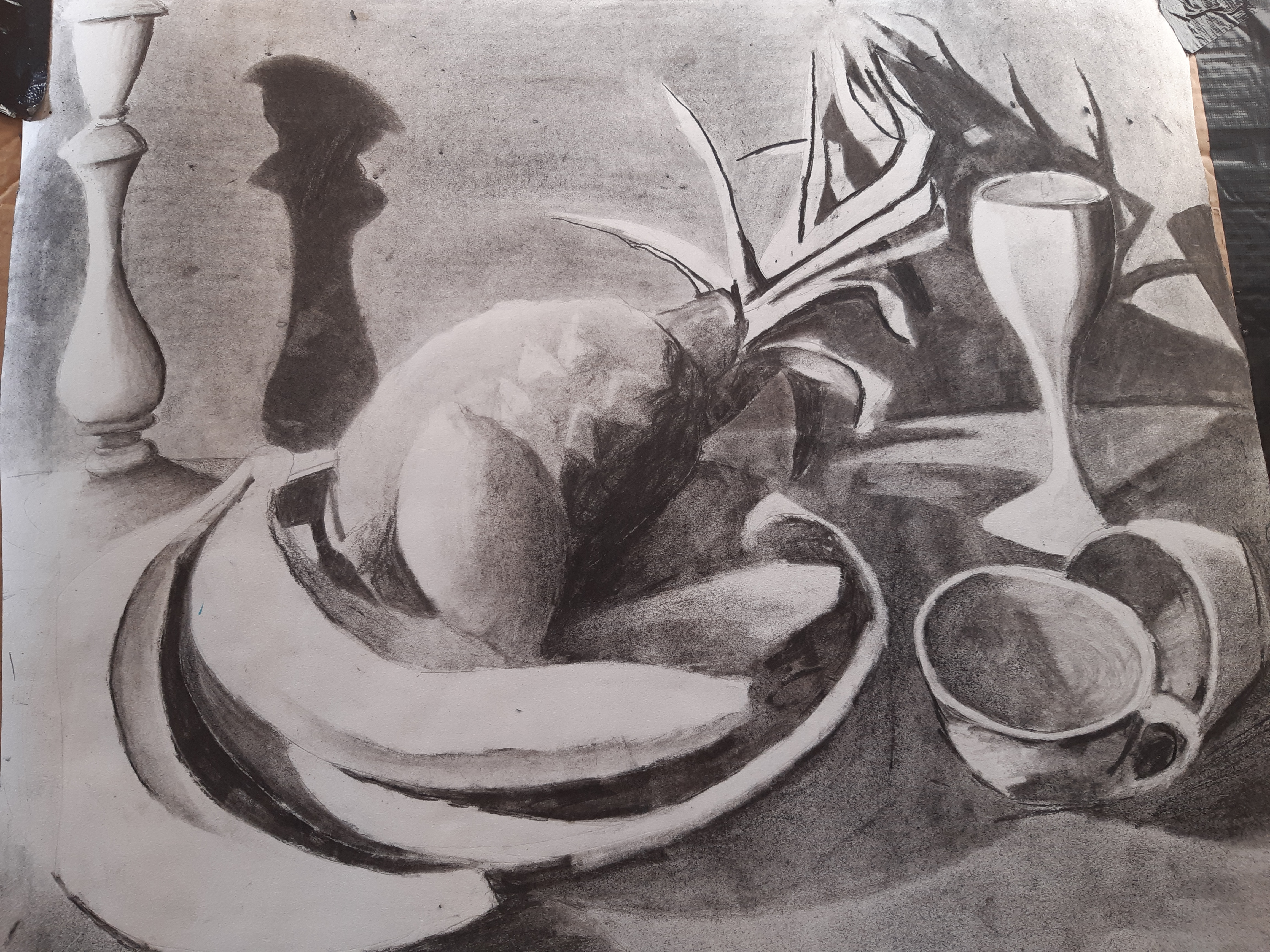
While I started this drawing I wasn’t used to the charcoal powder and I nearly scrapped it when I couldn’t get the background to how I imagined it. However I just went with it and it seemed to take on a style of it’s own. A lot smoother that I was expecting, but I think it worked out well, just not how I imagined. It also taught me how far I could push the charcoal which gave me a little more confidence with it for later projects. I liked the larger scale with I think charcoal also lends itself too.
Review of last two exercises.
Between suggesting 3 dimensions with natural and man-made objects, I just found that I had to approach them in a different way. I imitated the contour lines of man made objects to make the cross-hatch almost wrap around the objects to give a sense of shape. With natural objects I followed the grain of the shapes such as driftwood on shells. I found that this described the feeling and texture of the objects better.
To create a sense of solidity I tried to imagine the whole object, even the sides that were not visible. I imagined picking them up a feeling the shape and texture, what it would feel like, how I reacted to it. If I visualised this, and I had a better understanding of the object, I was able to imagine it clearer and found it easier to draw more of a solid shape.
Changing the arrangement was a big part of creating the story of the composition for me. By placing objects away from the group you can create pity, spacing them out of bunching them up can create different reactions of separateness or clutter and confusion, of interest by using repeating shapes. Not just changing the arrangement, but the view point can give interesting effects, an under head view can create a feeling of dominance whereas a close up can completely distort the composition beyond recognition.
Even subtle changes in light, arrangement and view point can alter the emotional response of the viewer to the composition.
References.
(1) Qoute ‘ Simple put, the definition…….between the subject’. https://mymodernmet.com/negative-space-definition/
(2) Hasegawa Tōhaku. Cranes in Bamboo Grove, 16th century (Momoyama period). Pair of six-panel folding screens; ink on paper. Idemitsu Museum of Arts, Tokyo. https://artssummary.com/2018/03/26/a-giant-leap-the-transformation-of-hasegawa-tohaku-at-japan-society-gallery-march-9-may-6-2018/
(3) Quote ‘Space is substance…..A serious omission’, from Alan Fletcher’ book, ‘The Art of Looking Sideways. https://new.uniquejapan.com/ikebana/ma/
(4) P56 ‘The Seven Deadly Elements, Second book Une Semaine De Bonte’, Cut and paste, printing press. Ernst M. Dover Press
 Eeyanski Arts