
For this research I decided to do a direct comparison of four radically different landscape artists who treated the subject completely different from one another, but strangely, seemed to use similar themes to create the desired atmosphere they were intending, mainly:
- Size
- Textures
- Colour
- materials
The artists I chose were:
- J.M.W Turner
- Paul Nash
- Richard Long
- Tacita Dean
Each artist I chose had a radically different way of expressing ‘the landscape’. From Dean’s almost technical monochromes, to Nash’s confusing upheaval of war torn, almost surreal landscapes, Turners genius use of natural movement and unique painting techniques, and Long’s beautiful use of the actual landscape itself to portray his feelings, I found this a fertile ground for comparison.

Starting with Dean’s ‘Fatigues’ set of 6 chalk on blackboard depictions of the Afghanistan mountains, these pieces are so impeccably detailed that the movement and grand scale of the mountains are beautifully recreated in these vast chalk drawings.

The pure power and strength of the rock faces are only emphasised with the simple black and white medium, (2), casting aside the distractions of colour for a full on representation of hard texture, whether it be crags, buttresses or summits they are all treated in the same medium to give a combined sense of awe, without the confusion of colour. Her heavy use of negative space, almost like the negative of a photo was explained in an interview (3), “I (Dean), had to copy it from his negative, because the positive was too difficult too read. So it was all about reversal from negative to positive, about drawing and photography.” This seemed to be the start of a staple style in her art which was in fact her way to portray the sublime elements of the mountains and the sea to help her with her film narrative.
![IMG_3980[1]](https://eeyanskiarts.files.wordpress.com/2017/11/img_39801-e1510056179725.jpg?w=720)
Striking similarities in the effects of the power of nature can clearly be seen in the much earlier work of Turner, (4).

Even though Turner does use a rather muted palette, I felt the same sense of awe was created towards the mountains and the natural movement of the sky or sea that Dean was able to do with her chalk boards. (5).
![IMG_3983[1]](https://eeyanskiarts.files.wordpress.com/2017/11/img_39831-e1510057697977.jpg?w=720)
A sense of power, upheaval, and a nod towards the little control humans have towards the great forces of the elements, as in the detail of Hannibal’s crossing where the figures are dwarfed by the sheer force of the power of the weather. (6),(7).
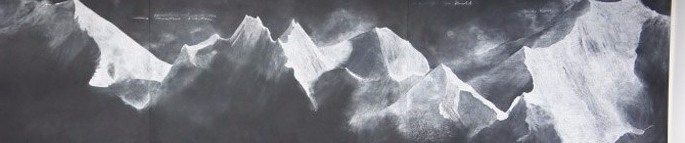
In both these examples, it is the lack of colour that has given them the power, with Dean’s chalk drawings it is the sharp ridges and scrawling undulations that convey the power and solidity of the rocks, Turner’s lack of detail and emphasis on movement simply gives way to expressing the sheer scale of the power of the elements.
Interestingly enough Richard Long managed to completely reverse the view of using landscape as ‘a’subject matter, and by using the landscape as ‘the’ subject matter.
![IMG_3988[1]](https://eeyanskiarts.files.wordpress.com/2017/11/img_39881.jpg?w=443&h=591)
Coming from a more sculptural background, he used his medium of ‘the landscape’ in a complete reverse of many traditional landscape artists. I’m not sure putting him in the same category is a wise move, but I got from his works a similar sense of awe and a feeling of sublime that both Dean and Turner gave me, but in a completely different way. (8), a simple line parted by Long on a 15 day walk through South America gives for me a sense of determination, not to overcome, but to become the landscape. Or even to present and draw attention to the vastness and greatness of the landscape by using a simple line. With a reductive nature he shows the expanse and tough, harsh qualities of the rugged terrain causing the viewer to feel the monotonous trudging over the pebbles and rocks just by imagining how much work and effort went into making that almost pointless, simple line.
A large scale to create that sense of greatness was also something Dean managed with her work with the blackboards.

I don’t think the sense of scale, vastness and strength could have been communicated with anything smaller than Deans, (9) ‘Fatigures’ set measuring 230 x 1110 cm; 230 x 557cm; 230 x 744cm; 230 x 1110cm; 230x 557cm; 230 x 615cm respectively.
Long also managed to take this sense of scale from a man-made mark outside to natural marks inside, when he began to take his work into the gallery and started to make vast circles and lines only using mud and his hands.

Not sounding too spectacular, this highly individual take on using the landscape as the medium, stylising the natural mud into unnatural straight lines, and doing it on a scale that wows the viewer with awe as much as looking at his miles of lines carved into the landscape, ‘Riverlines’ stood an incredible aprox 35×50 feet!
Paul Nash was another artist that was able to create a sense of awe and sublime feelings in his depictions of the destruction of human war fair through not just sheer scale, but his dark, limited palettes, simplified and crude detail and sharp uneasy shapes.

Standing almost 6 foot high and over 10 foot across this towering depiction of rugged bomb holes, trees stripped of their branches and life hung motionless in front of a catastrophic sky, grey dank clouds and destructive plumes of smoke over cast two small soldiers appearing lost and bewildered on a broken road to nowhere. His use of muted greens and greys strip the scene of any fertile life, as does the stagnant pond and rough, craggy slabs jutting out of the foreground. His stylised, simplified use of detail and blotchy brush work emphasise the stripping of nature and growth, accentuating the tragic impact of war on the landscape. Hopeless, up heaved and lost. The sheer size draws in the viewer to become part of the destruction, and allows them to feel the cold, harsh reality of man made war, just as Dean’s huge depictions of the Afghanistan mountain ranges put you clinging to the harsh solid peaks, against the unforgiving weather.

I was lucky enough to get to see some of Nash’s works at the York Art Gallery, which consisted of a lot of his sketches. However I could see a certain eerie stripping of nature in some of them that he seemed to portray in his works depicting the war.
The same haunting muted palette of blues and greens can be seen in (12) ‘The Elms’, as well as the stylised, almost childish shapes of the leaves like over grown mushroom clouds billowing above the dark terrain. And to a lesser extent in a much later work (13) ‘Milk Churns’ where we can see in a sketch and a photo the stripped trees, stark road and lonely milk churns, almost devoid of life, hopeless and bare.

I felt that all these artists were able to involve the viewer with their highly individual styles, yet used strangely similar ways to convey the message of landscape. depicting it with their personal attitudes to the expanses they saw before them. And all radically different from one another.
References.
Featured image – Detai l of ‘Fatigues (E)’ Dean T. (2015)
(1). ‘Fatugues (E)’ T. Dean, 2012 Chalk on blackboard, 1200x734cm https://www.designboom.com/art/chalk-on-blackboard-depictions-of-afghanistan-mountains-by-tacita-dean/ image via contemporary art daily.
(2) Detail ‘Fatigues (E)’ http://das-buero.stephanieboisset.net/docu-video/
(3) (P25) ‘I had to copy it from his negative…..’ exert from interview from book, Tacita Dean / Jean-Christophe Royoux, Marina Warner, Germaine Greer, London : Phaidon, 2006.
(4) ‘Hannibal and His Army Crossing the Alps’, 1775-1851, J.M.W Turner, oil on canvas. Photo from The Tate Britain. London.
(5) (P26,27) ‘Dear Little Sister’ 2002, Diptych 244×488. Photo from book, ‘ Tacita Dean / Jean-Christophe Royoux, Marina Warner, Germaine Greer, London : Phaidon, 2006.
(6),(7) Details from ‘Hannibal and His Army Crossing The Alps’, photo from The Tate Britain. London
(8). (P13) ‘Karoo Line’, a fifteen day walk in South Africa. 2004, Long R. Photo from book – Richard Long – Heaven and Earth. Tate Books.
(9). Tacita Dean, Fatigues (Installation view), via Marian Goodman Gallery. Web: http://artobserved.com/2013/03/new-york-tacita-dean-fatigues-at-marian-goodman-gallery-through-march-9-2013/
(10) Instellation of ‘Riverlines’ at The Hearst Tower NY2006. Photo from book, Richard Long – Heaven and Earth. Tate Books. (P30-31)
(11) ‘The Menin Road’ 1919, Nash P. Oil on canvas, 1828x3175mm https://en.wikipedia.org/wiki/Paul_Nash_(artist)
(12) ‘The Elms’ 1916, Nash P. 1916. Photo from the York Art Gallery
 Eeyanski Arts