
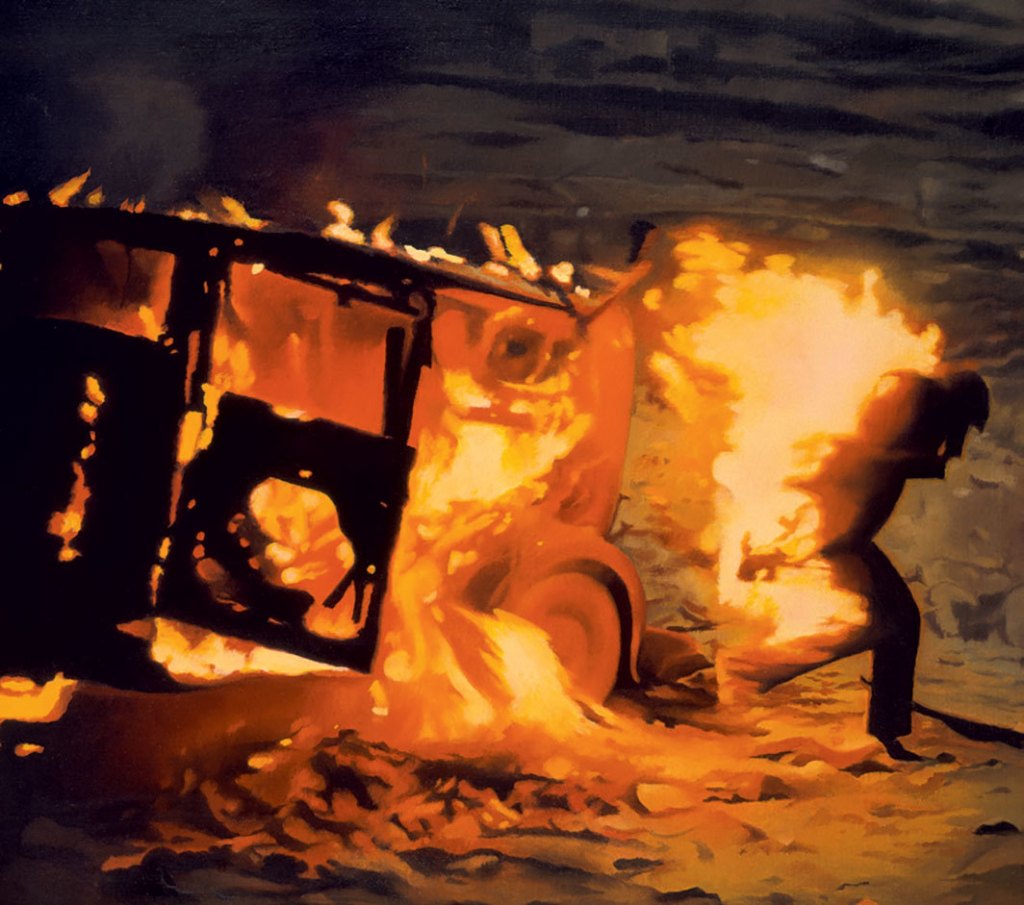
Whilst researching clouds and looking into the different formations, colours and the like I came across an American artist called Vija Celmins. She struck me as having an interesting background being born a year before the start of the Second World War I think this had a profound influence on her art work. Going through a faze of copying clippings of images of the atrocities of the war, such as (1) ‘Burning Man’ 1968, i was interested in the shift from these types of images to her serene scenes of oceans, deserts, the sky and the stars.
For one thing that struck me was that all of these things were great expanses. Typically the greatest we know. The expanse of space, the baroness of the desert and the vast stretch of the sea.
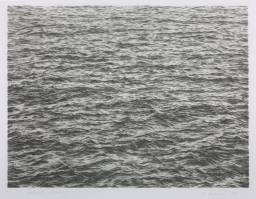
Painstakingly etched out over years from a pencil drawing it depicts the ocean surface which fills the frame. As mentioned before, what is in reality a vast open space is resorted to an almost claustrophobic and overwhelming window into an almost alien array of shapes and minute detail, in complete contrast to the scene of looking out onto the ocean, Clemins has literally put the viewer looking ‘onto the ocean’, such as in (2)’Ocean’ below.
The reason why this and her other paintings, especially (3) ‘Sky’ 1975, and (4) ‘Night Sky’ 1998′ made me start thinking about them was not necessarily to do with skies, it was how she transformed a moving living scene into something completely unfamiliar and alien. A view we would never have noticed.
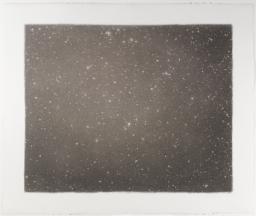
(4) ‘Nightsky#19’ 1998 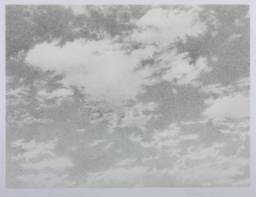
(3) ‘Sky’ 1975
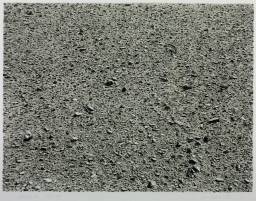
In a short Tate interview I saw on youtube when someone commented that it was like looking through a window, Celmins refused, explaining it was more like (5) “taming an image from the outside, for the inside”. Once I heard this I understood where she was coming from, (5) “It’s kinda like being there, you can get the essence”. It reminded me of the way I was thinking when looking at the clouds, only in reverse. Instead of looking up close and seeing something familiar look abstract. I was looking at something far of and trying to make it look familiar by grouping the abstract intricate undulations of the cloud and trying to get the essence of it, for even though they are always changing, each type of cloud, cumulus, cirrostratus, nimbostratus each have there own essence that tell them apart. As does each desert (6), or each starry sky.
I think possibly the link between her reaction to the war and these remote, detailed pieces was a longing for solitude and peace. The beauty of the vastness of nowhere. She quoted,
(7), “Remember – we live next door to the ocean, but we also live on the edge of the desert. Los Angeles is a desert community. Beneath this building, beneath every street, there’s a desert. Without water the dust will rise up and cover us as though we’d never existed!
(pausing, letting the implication set in).
The irony of safety in the open vastness as a place get lost and never found, mirrored by her artwork of vast places where all you can see is the detail on the ground.
References
(1) Clemins V, ‘The Burning Man’, 1968. Oil on canvas. 20″x22.5″ Web: https://www.artforum.com/print/201901/jordan-kantor-on-the-art-of-vija-celmins-78005
(2) Clemins V, ‘Ocean’, 1975. Lithograph on paper. 317x420mm. Collection The Tate. Web: https://www.tate.org.uk/art/artworks/celmins-ocean-p78336
(3) Clemins V, ‘Sky’, 1975. Lithograph on paper. 315×420mm. Collection The Tate. Web: https://www.tate.org.uk/art/artworks/celmins-sky-p78334
(4) Clemins V, ‘Night Sky #19’, 1998. Charcoal on coated white paper. 618x718x38mm. Collection The Tate. Web: https://www.tate.org.uk/art/artworks/celmins-night-sky-19-ar00163
(5) Quote: All from interview by Tate Gallery, Vija Celmins – ‘Painting Takes Just a Second to Go In’ | TateShots. Web: https://www.youtube.com/watch?v=SsbkzSrCdIg
(6) Clemins V, ‘Desert’ 1975. Lithograph on paper. 315 × 416 mm. Collection The Tate. Web: https://www.tate.org.uk/art/artworks/celmins-desert-p78337
(7) Quote: “Remember – we live next door….cover us as though we’d never existed!
(pausing, letting the implication set in) – exert from papers written by Celmins extracted in an article by the Tate on her painting ‘Desert-Galaxy’ 1974
 Eeyanski Arts