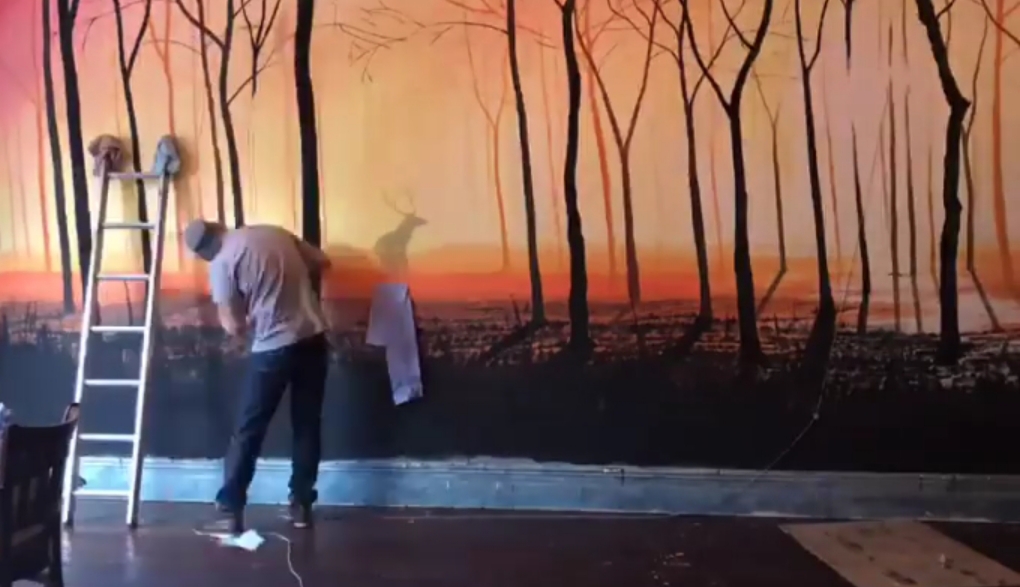

Foreshortening is a technique used by artists to create emphasis, distortion and maybe a little confusion and interest to a drawing or painting.
It uses extreme closeups and unconventional angles to portray the model as they would actually look like if your eye was as close to the subject as it is painted, creating an emphasised and elongated viewpoint that say a small animal would see looking up at a human. Usually painted from above or below, this makes the models proportions almost comical, unrecognisable and sometimes grotesque.
Foreshortening became fashionable around the Renaissance time, giving the painting a more dynamic feel to them, especially the larger figure drawings and frescos.

In this detail of one Michelangelo’s frescos you can see the depth of the character create by the hand in the foreground as the body reclines into the background as it gets smaller the further away, the cherubs matching the receding lines as getting even smaller the depth is all the more increased.
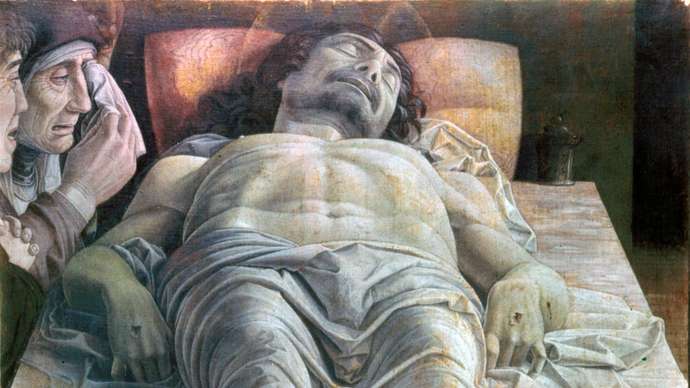
In more modern art we can see the concept of foreshortening taken to an even further extreme to create some often amusing pictures, mainly using the human body this has been helped by the use of cameras and the ability to take extreme closeup of the model from angles the artist might not have been able to reach, ie from above or below.
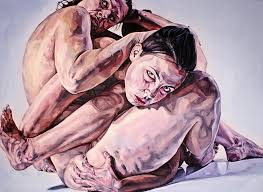
This has give artists a chance to experiment with all kinds of imaginative poses such as Duarte Vitoria’s dizzyingly large canvases of close up body parts such as feet, hands and arms and faces reclining.
Duarte Vitoria
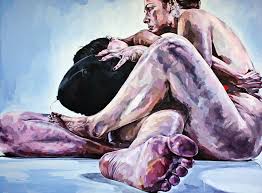
(4) ‘In Fusion’ Vitoria D. 2015 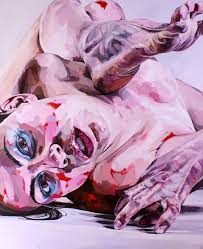
(5) ‘Revolution’ Vitoria D. 2014
These shocking, almost tortured looking models seem twisted into unnatural, painful contorts are both bold, but beautiful in a rather dark way. The use of heavy contrasting tones of harsh light and the muted palettes of blues and greys splashed with mottled reds give a sense of morbidity and sadness, verging on torture. A truly striking set of portraits.
Another couple of contemporary artist that drew my attention were Jenny Saville and Fred Hatt.
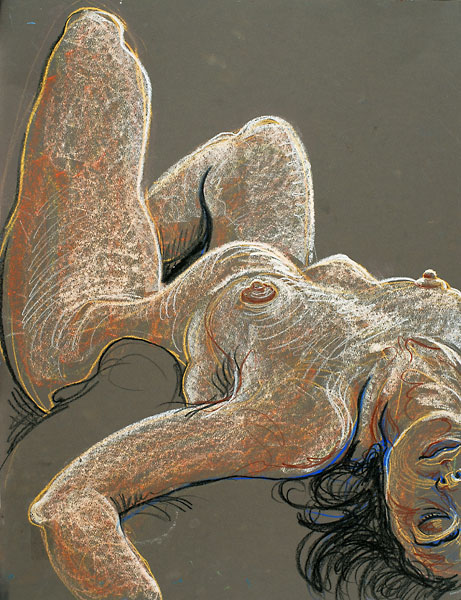
(5) ‘Dynamo’ 2010. Fred Hatt 
(6) Jenny Saville (1970-), 1992
Both these artists seem to use striking lines take the viewer back a bit and blink at there rawness. I like that as it shows me a reality and harshness that really capture the inner feelings of the artists, an ability that is both difficult to master as well as to execute.
Fred Hatt has a lovely raw and free use of not only his lines, but also the way that manages to blend the colours together to emphasise the contours of the body and create contrast with the highlights.
Saville’s portrait is perfectly rendered to convey her message as ‘Yeah, what you looking at!’ Sat high looking down on the viewer gives a dominating character and as I look up from the bottom, to me the feet say ‘insecure’, the hands show hatred to her body almost clawing at her thighs, but finally getting up to the face it says I know what your thinking, but I don’t give a shit!
Cover picture: Detail of ‘Separation of The Earth from the Waters’. Michelangelo
(1) ‘Separation of The Earth from the Waters’ (detail). Michelangelo D. 1511, fresco. Web: https://commons.wikimedia.org/wiki/File:Michelangelo,_Separation_of_the_Earth_from_the_Waters_02.jpg
(2) Detail of ‘The Mourning over the Dead Christ, tempera on wood panel by Andrea Mantegna, c. 1475(?); in the Pinacoteca di Brera, Milan. Web: https://www.britannica.com/art/foreshortening
(3) ‘Into the Dark’ Vitoria D. 2014 Oil on Linen 73″x982″. Web: https://www.walnutcontemporary.com/duarte-vitoria
(4) ‘In Fusion’ Vitoria D. 2015 Oil on Linen. 79″x108″. Web: https://www.walnutcontemporary.com/duarte-vitoria?lightbox=dataItem-ip08v3581
(5) ‘Revolution’ Vitoria D. 2014. Oil on Linen. 63″x79″ Web: https://www.google.com/search?q=revolution+duarte+vitoria&rlz=1C1CHBF_en-GBGB924GB924&source=lnms&tbm=isch&sa=X&ved=2ahUKEwjX57z9qZ7vAhUDZcAKHdBBDNIQ_AUoAXoECAMQAw&biw=1280&bih=610#imgrc=vlvYFdKg4FNVvM
(6) Jenny Saville (1970-), 1992, oil on canvas, 213.4 x 182.9 cm. Image via Sotheby’s. Web: https://www.barnebys.co.uk/blog/jenny-saville-or-the-art-of-the-sculpted-nude-on-canvas
(7) ‘Dynamo’ Fred Hat 2010. Web: https://fredhatt.com/blog/author/fred/page/27/
 Eeyanski Arts
