
So now we take a leap to the actual human figure and I started off this exercise by building up some confidence with my techniques when drawing the figure.

I found that the best way to work when you have an allocated time is to work systematically. Not necessarily to a systematic ridged style, but an underlining method which you can work with and are able to paste and style what you feel like expressing onto that frame work.
My reasoning for this is the time limit, especially if you only had a minuet, or even 30 seconds to express the form you are looking at, it is really important to be able to strip it down to its essentials. Once there, and allocated more time I came up with a system of adding certain details and features depending on the time limit.
- Starting with the head I would put it in the position and angle it’s facing and draw an arc to express the direction of the gaze. Then a short curve to indicate the relation of the neck.
- I can then map out a simple arc of the position and angle of the shoulder line.
- I would then take note of the flow of the spine and curve a line down to the navel and loosely follow it down the direction of the leg to get the overall momentum of the pose.
- Circling in the position of the shoulders next.
- Drawing in a triangle to express the torso, with an upturned arc just below to map the mid riff.
- In relation to that, just below a down turned arc for the position of the abdomen, and an upside-down triangle for the abdomen.
- Two circles for the placement of the buttocks.
If I married this up with the initial spinal curve I found I could circle in the limbs with a reasonable accuracy.
With one minuet to utilise I found this way a quick and simple way to concentrate on the gesture of the model without having to worry too much about detail.
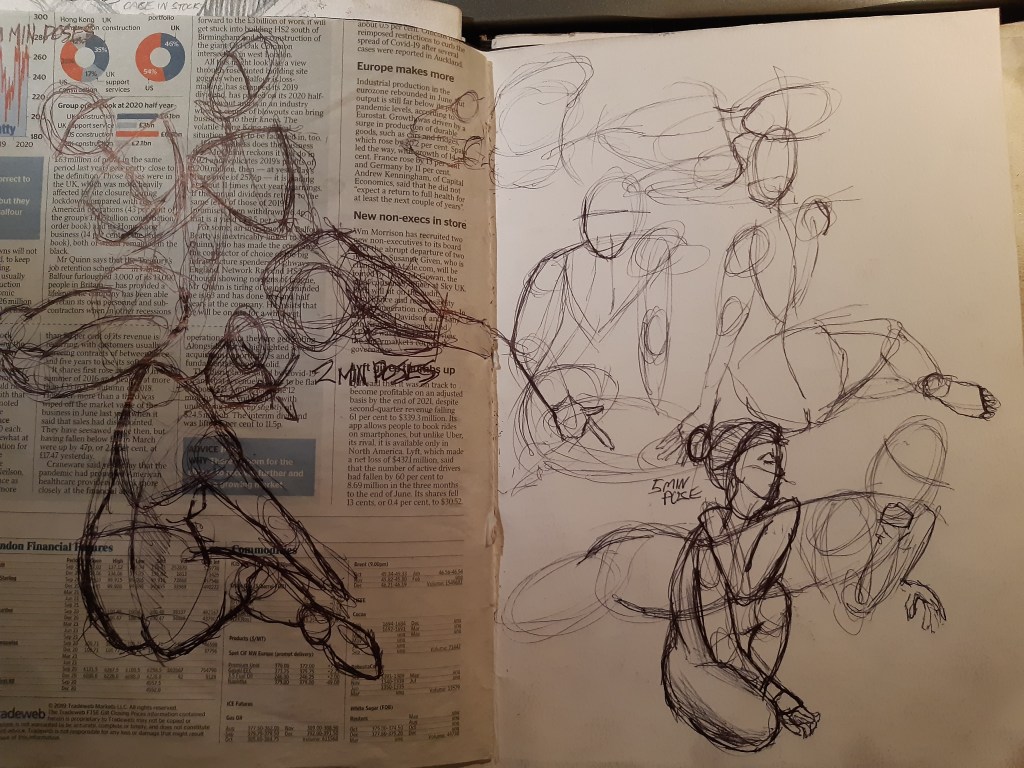
Then with more time, I could define the image more and more with line, but it gave me all the basic proportion and movement that I needed to build on without getting hung up with detail.
After some experimenting and practice I chose a pose and made 5 2 minuet sketches using the system, but in different styles to see how versatile it could be. So I could see that a system didn’t necessarily have to be robotic and produce identical outcomes. Even using the same medium. Here I used a graphite pencil.
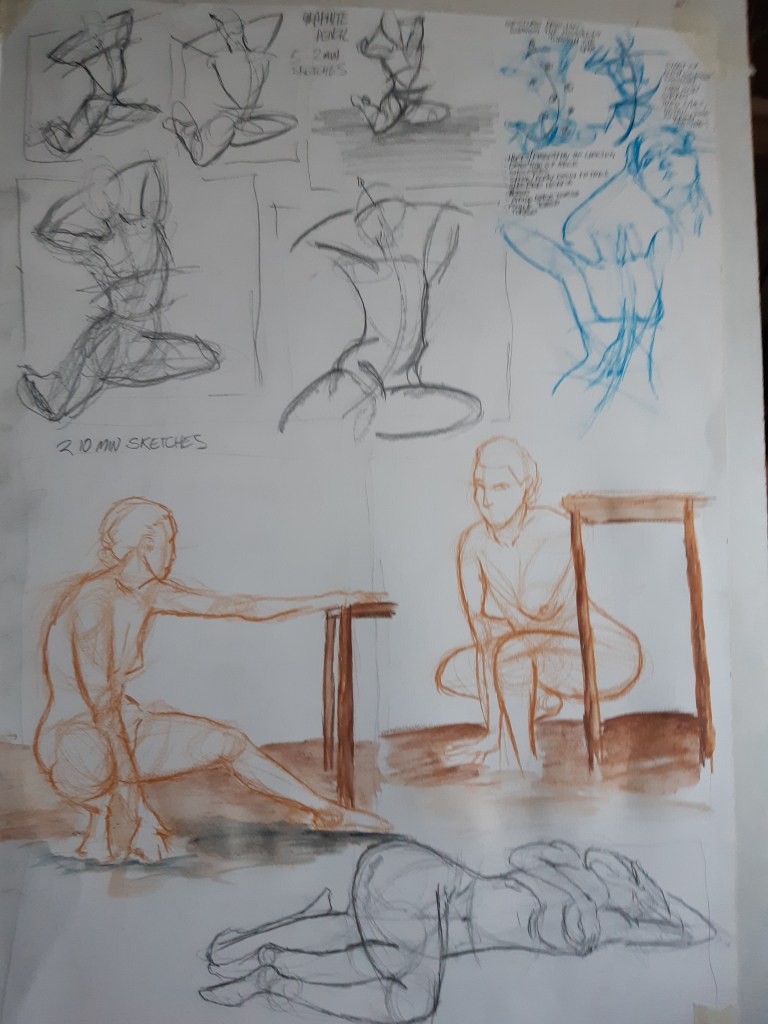
This was quite successful as I managed to use the graphite pensil in different ways, but still stuck to the above system of putting them together in 2 minuets.
Below this was two larger 10 minuet sketches in water colour pencil of a different pose, at different angles. A bit more challenging, but interesting to see how different the shapes were from a slightly different view point.

I found anchoring the tilt of the head and placing where the gaze was set helped put the model into place. Then the twist of the neck naturally led to the movement of the spine. Placing the head first enabled me to judge the arc of the shoulders more accurately and from there everything else seemed to fall into place. As I noticed when drawing the statues and mentioned earlier, I’ve been trying to include the shape and position of the feet and hands also, as much as I can as I believe they are a great way to convey emotion, movement, strength, weakness and an openness about the deep feelings of the pose that is trying to be conducted. Which is probably why they are the hardest things to draw on the human figure!
 Eeyanski Arts