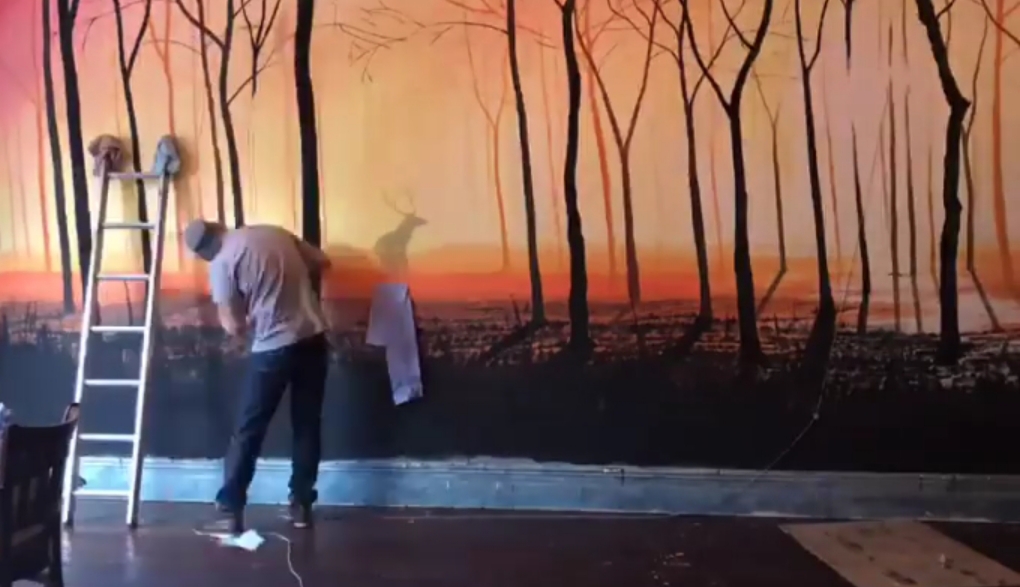

Looking at the stance of a model is a great way to understand the dynamics and pivot points of a pose, and how the torso and limbs work together to create balance and flow.
It also helps to put together a convincing figure when the centre line is aligned with the angles of the arms and legs, giving the model a harmonized, natural pose.
Interestingly contrapposto, or counterpose was an theme of ancient Greek statues, supposedly giving them an air of movement and grace.
(1) ‘An Italian term meaning “counterpose,” contrapposto refers to a now-canonical stance in which a figure stands with their entire body weight supported over one straight leg and lets their arms fall in opposite directions to create a natural-seeming twist in the torso.’
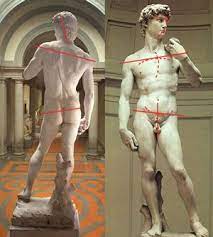
This is just one example of body mechanics that can help with identifying the centre of gravity and how the form creates a balance around this, and becoming aware of it aids in composing a more realistic pose.

For this I decided, instead of getting a ‘model’ to pose, I would watch my Dad fixing his van. This gave me much bigger scope on natural pivot points and a more interesting variety of a centre of gravity in poses. Granted a lot of the poses looked like he had badly injured himself, or was about to, or had already passed out, but I assure no one was harmed in this drawing session.
I did some sketches of various poses and tried to identify the balance point or centre of gravity, the pivot point of the stance and the direction of the movement to get an idea of how the rest of the body, head, arms, legs worked in conjunction. This was interesting because I noticed that without being put in an unnatural position, the body tends to ‘sway’ and move in a uniform way depending on where the weight is distributed. This is useful when identifying the form of a pose, as it can be remembered easier by the artist so concentration can be focused on other aspects like light and tone.
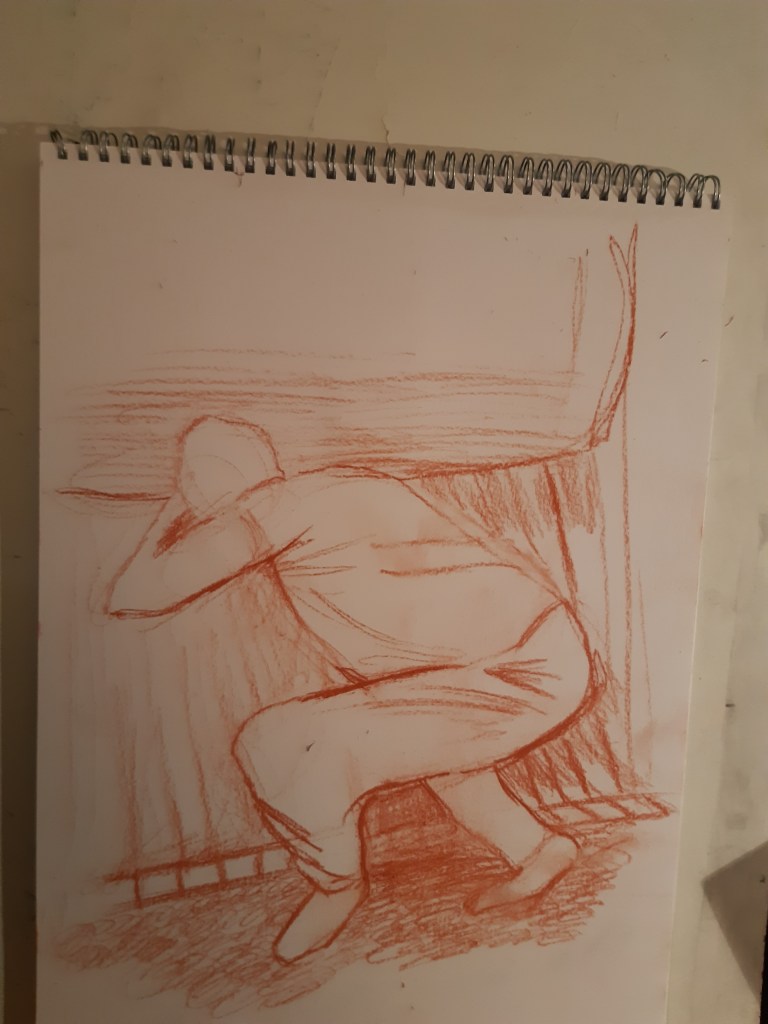
I finished off with a final sketch on A3 which, I do agree, makes my Dad look like he had drank a little too much, cried, and is actually about to pass out but I can assure this is what someone who is fixing a van looks like when you pay attention.
A few important aspects I picked up from this exercise is the relation between the angles of the shoulders and the hips of a pose. The centre of gravity running from the back of the head to the pelvis along the spine, which will usually confirm how the legs are positioned to support the weight of the upper torso. And also don’t give a mechanic raw alcohol.
Reference
(1) Quote by Sarah Gottesman, Artsy journalist. Web: https://www.artsy.net/gene/contrapposto
(2) Example of contrapposto, Michelangelo’s David statue. Web: https://scalar.usc.edu/works/ancient-art/media/contrapposto
 Eeyanski Arts