
I enjoyed this task. Possibly one of the most challenging to date, and it opened up a number of questions for me that forwarded to a number of leads towards underlining practices, not just with drawing what you see, but exercising my memory muscles and my spacial awareness of where my pencil is making marks, with regards to how long I am looking at the paper in relation to how long I am looking at the view/model in front of me. Using this muscle when there was no image in front of you, I found out is a lot easier than it sounds!
This was an exercise that made me aware of the internal picture an artist builds up, for me, somewhere between my brow line and the centre axis of my head, I found that if I could concentrate on this region I was able to draw simple geometric shapes without looking at the paper. It took a bit of practice, but I managed to become more intimate with the motions of my mark making, more accurate, without looking at the page, I was fundamentally creating a mental image of what I was looking at, and relaying it with the confidence of my physical movements. The first few attempts were nothing to shout about, but the switch in concentration between drawing an image in front of you and transferring that image to a page, compared to cutting that visual/articulate/movement/action in normal drawings, to visual/memory/action, with no reference was something that came as a bit of an ‘eyeopener’ to me, (in a good way).
“Learn how to draw what you see”
“Now close your eyes and draw what you don’t see, but feel”
Before I carry on, the comment I made above was originally coming from one direction with regards to drawing not from a reference, but from memory, hence the exercise. Re reading it, it could also be interpreted as how an artist can ‘feel’ or put emotion into a portrait, such as I have described in previous posts.

pencil sketches of geometric shapes blind, various anatomy not looking at the page 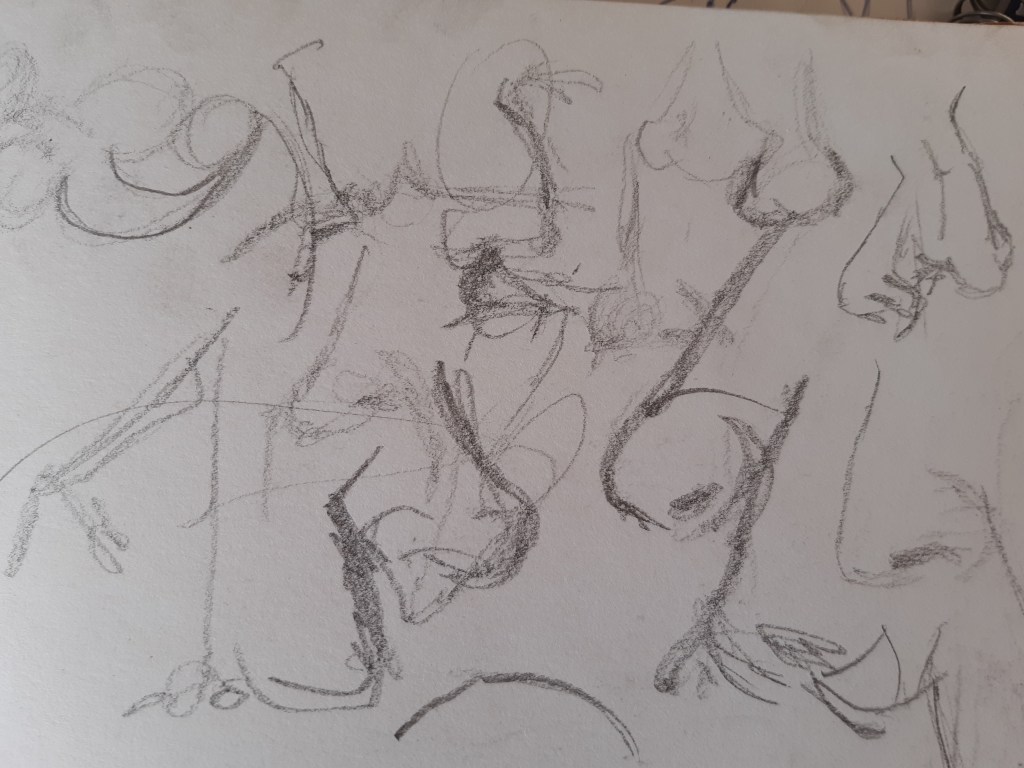
pencil sketches of noses while watching moving characters in a T.V series.
Although I wanted to focus this exercise on a more technical level I liked the idea of drawing a portrait from a description of a character in a book. Brilliant! I love books for the fact that they create images in the mind, kind of like a personal cinema screening, but the reader is in control, so I thought it would be interesting to see if I was able to re create the images of the characters in some of my favourite books, that I had built up in my head, and manage to put them onto paper…….I’m very intrigued, and this is what I learnt about my abilities, stripping the visual image and solely using my imagination.

Dean Moriarty, from Jack Keroack’s ‘On The Road’, (portraying a real life Neal Cassiday), Nell’s grandfather from Dicken’s ‘Old Curiosity Shop’ and R. P. Mc Murphey from Ken Kesey’s ‘One Flew Over the Cuckoo’s Nest’, (who was also rumoured to be based on Cassiday).
I found drawing from imagination pulled me more towards the caricature elements of the face. It was my imagination that took over, and I found it quite difficult to fix an image without thinking about it too hard. Without a reference I had to fill in the gaps so to say, and my images ended up becoming almost comic.
However, these were the factors that, at my level of understanding, could describe in drawing terms, what was written in the books, hence aiding my imagination.
Keroack’s description of Dean (Cassiday) was short, but I got an idea of his personality through the next pages of his description. After I drew it I googled his picture and realised how much I had missed the mark!


Realising how difficult it was to draw without a reference, but also how important it was to hone those skills to be able to draw without a reference.

These were the images that I could come up with for the three characters from the books mentioned above. Still, I felt I was relying on my limited imagination to portray what I was reading. This was the next point I decided to look at.
‘The Illustrated Man’ from Ray Bradbury’s Something Wicked This Way Comes was skilfully depicted by Bradbury, and I used the vivid, almost dreamlike qualities of the oil pastel and turps to try and bring this character to life.

‘Mr Dark’ oil pastel and turps. A4

I drew this in a base coat of oil pastel and turps, layered it with pastel, biro, coloured pencil and conte to give a real description of what Bradbury portrays in his book. ‘His eyebrows, his hair, his suit were liquorish black,’….it was the suit….for it seemed woven of boar bramble, clock-spring hair, and a sort of ever trembling, ever glistening dark hemp.’
‘His shirt sleeve pulled up….’
‘Bright purple, black, green and lightning blue ells, worms, and Latin scrolls slid to view on his wrist.’
Making me aware of drawing from imagination, and realising my own limits as to what I can imagine and what I can draw in comparison to what I can draw from seeing it in a physical sense, has taken me on an un expected path, exploring drawing exercises such as ‘blind drawing’, expressing movement in a figure and contour analysis, concentrating on the form in front of me without any visual bias.
 Eeyanski Arts