
An interesting concept is the fact that even though we perceive and accept the object we see in front of us as recognisable things, a plant pot, your friend, a building etc, it’s usually only when you try and draw something in extreme perspective, close up, or from different angles, that you realise just how different the object looks. Sometimes even unrecognisable.
There are a few interesting artists who took this idea further and based a large body of their works on this idea such as David Hockney with his photography, to more contemporary artists like Graham Greene and Rorik Smith with their almost nauseating depictions of interiors. The there are artists such as
David Hockney
Most known for his famous bold Pop Art style, Hockney is less well know for his influences from Japanese scroll art. A clip of his film ‘On Perspective and Looking’ can be found on youtube https://youtu.be/mrFDGct4kH8 (Uploaded 2009 Jackschulze) showing the Artist talking through an ancient scroll that used multi perspective to show off different angles of the houses and ridges along the river.

Maybe through his love of photography he started to do interesting photo collages, using an amalgamation of photos, although rather organised, showed different angles and distances of a single object.
Most notably in pictures like ‘The Desk’ quite a formal approach to multi perspective, with well laid out grids and mainly a distortion of distance rather than angles and perspective. This did spark off some inspiration though as I liked the free use of the camera frames collaged together.
We see a more distorted viewpoint in his drawings, ‘Two Pembroke Chairs 1985’ and ‘Pembroke studio with Blue Chairs and Lamp 1985’.

In these illustrations we see Hockney really pushing the multi perspective, creating an almost unnerving claustrophobic feel to the rooms. His use of harsh angular lines crashing into each other exaggerate the urgent clash of angles, almost scrawled into the page, it definitely puts forward a feeling of unease and disarray, despite the use of bright colour.
A number of more contemporary artist have taken this technique to a much more nauseating level, such as Rorik Smith.
Rorik Smith.

Smith is an Artist and draughtsman based in North Wales, and specialises in extreme multi point perspective drawings of interiors that disorientate and boggle the viewer to a point where the need to rotate the picture more than 360 degrees just to understand where it should be viewed from. Even then I was still a bit miffed as to whether I was looking at it upside down or not!
I absolutely adore and respect Smith’s work. Not just because of the visual complexity of the drawings or his precise use of multi media, but because of his background knowledge of taking the notion of perspective and literally cutting and folding it off the 2 dimensional plane, recreating it into a solid mathematically engineered 3D form, then taking that image and re-representing back onto a 2D plane.
Using ideas such as polyhedral’s, “A three-dimensional geometric figure whose sides are polygons. Atetrahedron, for example, is a polyhedron having four triangular sides.” (8) to create multiple planes which can be folded into 3D shapes, and back out again to form flat planes. For me, this is taking the idea of pushing the painting past the conventional square or rectangular boarder onto a completely new level and into three dimensions. Stretched and distorted, yet still making mathematical sense, then being put back into 2 dimensions, this play on reality really interests me as it is both beautiful and awe inspiring at the same time.


Escher.
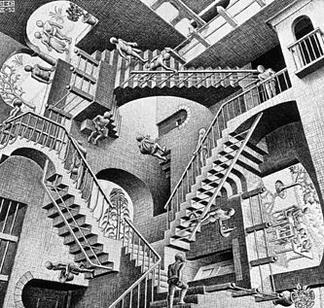
Another artist who used mathematical logic and successfully turned it into incredible and impressive art was M.C Escher. His black and white lithographs or ever increasing complexity are a superb take on merging multiple viewpoints with not only accurate, but pioneering, and highly individualistic style that I found both intriguing, confusing yet playful in a sense that I felt like he had just opened his door and welcomed me into his world.
Anthony Green.
Green is a renown RA artist who’s almost lovable depictions of what started out in the rooms of his own house, spanned out at all angles (literally) to portrayals of his garden, neighbouring church’s, buildings and other numerous domestic situations and stories.

His style is to represent a familiar homely scene with a twist on perspective so that the viewer becomes a little disorientated in an almost playful way. The bright bold colours such as in ‘The Studio’ give the sense of an almost innocent, childlike humour, also showing his persistence against drawing on a conventional square or rectangle frame. Another hint to an almost infantile rebellion against what ‘should be’. These Erratic angled canvases progress throughout his work, taking on an almost story like feel as you view from one end of the canvas, through the rooms and corridors of the house, meeting bold and eccentric characters on the way, little nooks and crannies revealing smaller figures and situations.

In these two pictures the interior seems more relevant to the 40’s-50’s than when they were painted. Both have similar chairs and lamps of a dated era, as with the clothes of the characters, maybe the artist was reverting back to a time of his childhood which seems to be an on going theme with Green. Especially with the depictions of his mother and her husband. I get a strong sense of dreams and memories in Green’s work from the way he depicts the floating, multi perspective, third person viewpoints, to the bright vivid, almost stylised colours and the symbolism of his mother, step farther and the often included depictions of the artist himself.
A powerful style that acts as an guide, piloting the viewer around the personal domesticity of the artists life. Very successfully executed, but personally I find it a little to self promoting and personal to Green for me to identify with it. However I do commend him on his use of frame and boarder, and I love the way he pushes the boundaries of conventional square or rectangular frames.
The artists I looked at were focusing on the manipulation of perspective which is a subject that fascinates me. Perspective in itself is an illusion that our brain conjures up to enable us to see the world around us. However, it is only one point of view, (excuse the pun) and by manipulating the math behind the perspective it’s possible to represent what we see in a more stark, imaginative and often dream like way.
References.
That’s the way I see it. David Hockney. Thames and Hudson.
01 – P118 ‘The Desk’ Hockney D. 01/07/1985. Photo collage
02 – P120 ‘Two Pembroke Chairs’ 1985. Hockney D.
03 – P121 ‘Pembroke Studios with Two Chairs and a Lamp’ 1985, Hockney D.
04 – ‘Studio West Classroom’ 2010. Smith. R. Distemper on canvas. 425x290mm. Web: http://www.roriksmith.co.uk/panoramic
05 – ‘Library Corporation St’ 2012. Smith. R. Wolff’s carbon pencil, conte, paraloid B67 on hardwood ply. 762x1221x9mm. Web: http://www.roriksmith.co.uk
06 – ‘Archives, Marine Terrace’ 2012. Smith. R. Wolff’s carbon pencil, conte, paraloid B67 on hardwood ply. 762x1221x9mm. Web: http://www.roriksmith.co.uk
07 – ‘Ex Libris College’ 2011. Smith. R. Wolff’s carbon pencil, conte, paraloid B67 on hardwood ply. 702x1221x9mm. Web: http://www.roriksmith.co.uk/panoramic?lightbox=image1wup
08 – ‘Relativity’ 1953. Escher M. C, lithograph. 27.7cm x 29.2cm. Web: https://en.wikipedia.org/wiki/Relativity_(M._C._Escher)
09 – http://www.dictionary.com/browse/polyhedral
10 – ‘The London Studio’ 1964-66. Green A. 127x170cm Web add: http://www.newenglishartclub.co.uk/artist/anthony-green-neac-lg-ra-rba-hon-roi
11 – ‘ the Embassy Lodge’ 1990. Green A. The Kelvingrove art gallery Web add: https://artuk.org/discover/artists/green-anthony-6-1939.
 Eeyanski Arts