
With angles, perspective and interiors in mind, the first idea that popped into my head was a perspective of my spiral staircase. I’ve always liked the way that the darkness rises from the ground floor through the banister posts to meet the skylight over head. There’s something mysterious about a curling set of stairs that seem to lead off to who knows where. So with this in mind I set about brainstorming some words to describe the impression and emotions I wanted to create for the viewer.
After contemplating the stairs for a while to get a feel for them I opened my log book and noted down what I was thinking. Words flowed from height (third floor) – steep – mysterious – disengage – confusion – movement – shock – nausea – balance – vulnerable – edgy – perspire – dare.
These being the first things that came to mind I decided they would be setting the scene so I worked around this theme by thinking about the best suited medium and colour scheme.
The orientation had to be tall and long, portrait without a doubt and I decided to keep the colours reserved to monochrome so the attention of the viewer would be focused on the atmosphere of the drawing and not distracted with colours.
I needed a medium which would give me a bold striking contrast to shock, but also to intrigue so I decided on charcoal and conte stick which would give me the effect of movement while keeping a bold line if I used them right. I would also be able to use them for small detail if need be.
I tried getting above the banister so I could capture the stairs meander down and off round the first corner but I was struggling to get any interesting scope, the perspective and lines were very flat and I was having to lean over to get any angle of interest.

Thinking back to the multi-perspective research point I remembered the photo collages of David Hockney which impressed me so deciding to take the idea of multiple photos, but to change the angles and depth of the pictures, I was able to literally walk down the stairs, changing perspective point which in turn completely distorted the angles and views I was able to make a more abstract collage of the ‘decent’ down the stairs, adding to the disorientation and nausea that I was trying to achieve.
Even though the picture is distorted and disjointed the lines of the banister, the hand rail, hand rail knob, the lines of the stairs and the skirting line on the wall are enough to make sense of the stairwell and orient viewer just enough to make sense of the scene.

The fast sharp lines of the walls create an almost sped up feel as if you were viewing scenery from a very fast moving car, dragging the viewer downwards and round the corner down the stairs and towards the shadows. The only thing that seems to be still is the handrail knob which creates an impulse to reach out and steady yourself!
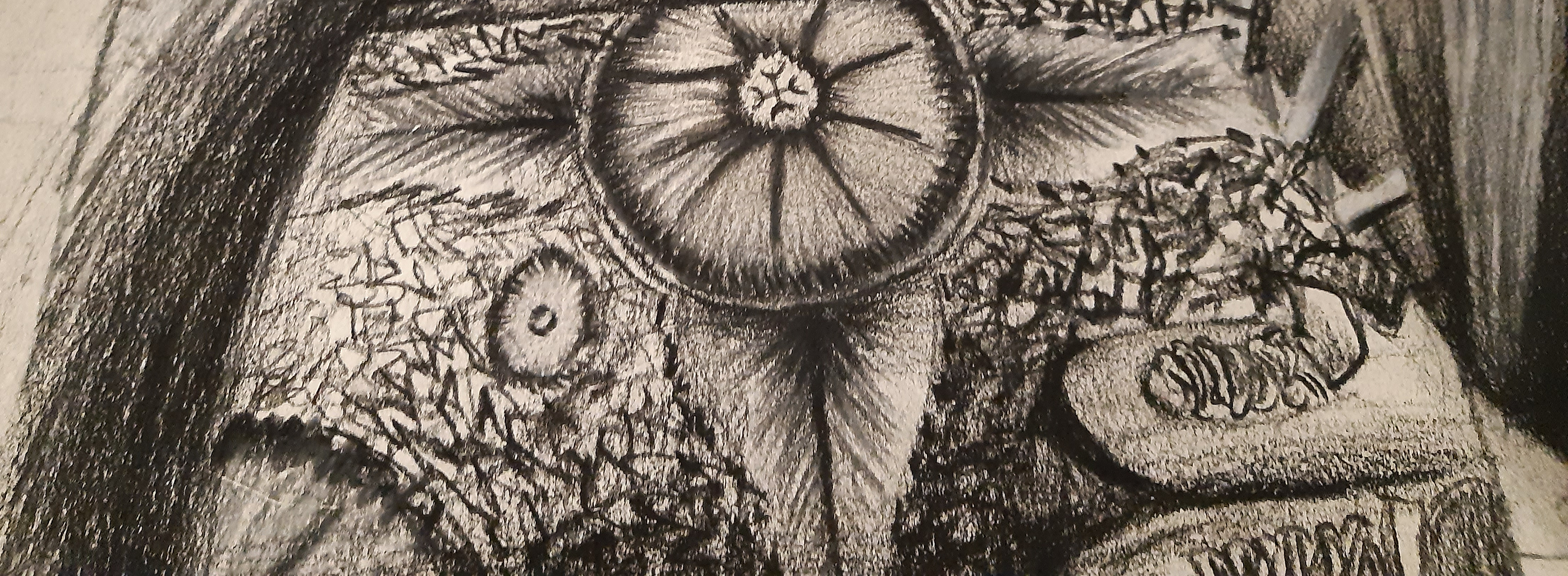
The viewer is placed directly on the top step next to a pair of shoes and can follow the repeating pattern of the carpet further and further down adding to the sense of vertigo. I set the detail of the carpet in contrast to the vertical lines of the banister posts and the go faster stripes of the wall paper so the viewer can still get a idea of the construction of the stairwell as well as being sure of which way is up and which way is down.
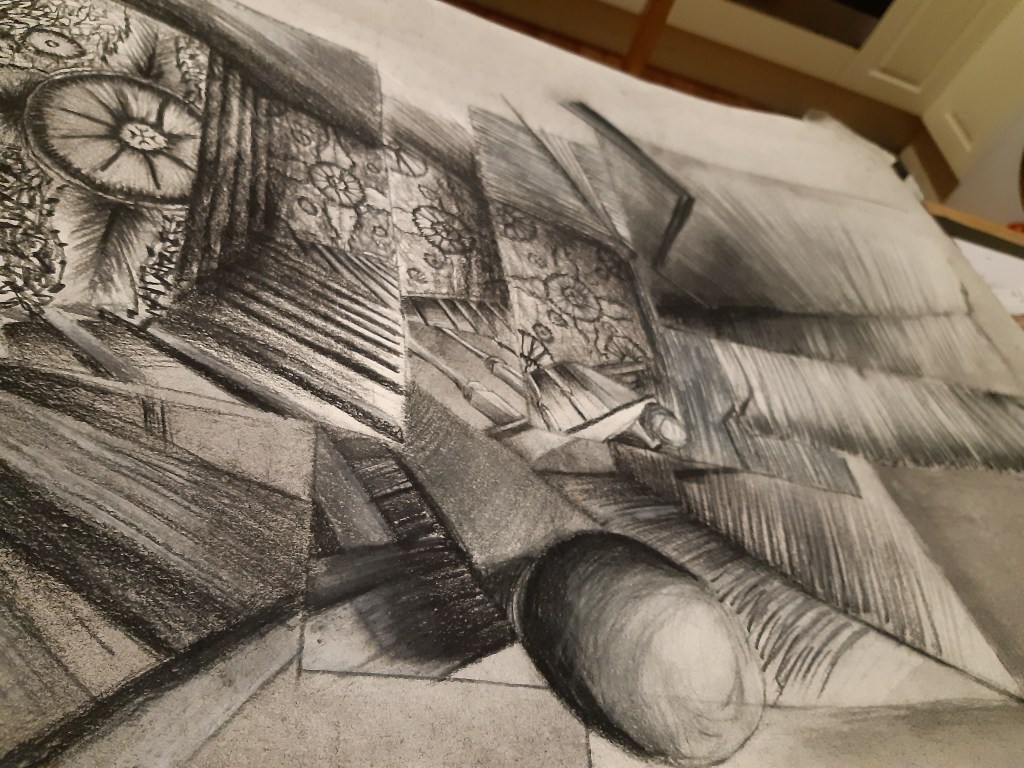
I realised that looking at it in relief actually made it look like it stood of the page which I found quite amusing, but after completing the drawing and looking at it for a while I also noticed that the image was quite successful in the position of the content in relation to how it guided the viewers eyes. Mentioning that I drew it to place the viewer right on the top step next tot he shoes there is no where else for them to stand. The focal point here is the pattern on the carpet which is the most detailed part of the picture and draws in the most attention, follow it down as the detail diminishes takes the viewer down with it, then noticing the walls are rushing by ahead the next thing to notice is the banister knob which would instinctively be grabbed for.
I think in this way the composition of the picture is quite successful in engaging the viewer and inviting them to take part in the narrative I was trying to portray.

Critique.
I found it easier to approach this exercise by first looking at the scene and writing down the first things that came into my mind. This way I was able to bypass second thoughts and try to render the drawing from my gut feel. Then working back from there it answered the questions for me with regards to medium and style. I will defiantly be working with this method on future exercises as not only does it draw inspiration, but is great to review when doing a write up as it records my whole thought process.
After completing it the only thing I would change would be the scale as if I were to do it larger I could have added more details and made it a little more intricate.
 Eeyanski Arts